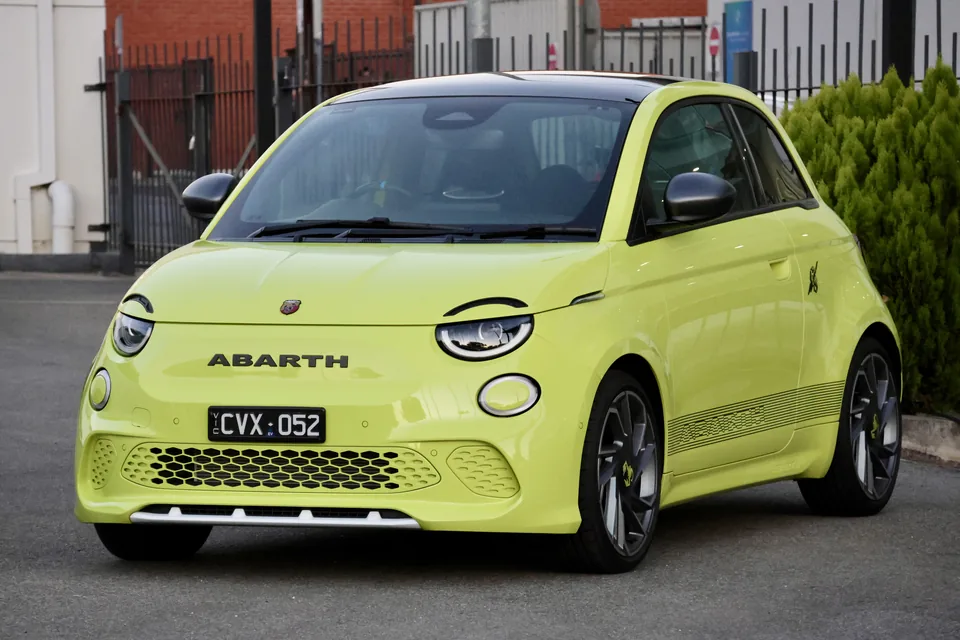
Abarth 500e
Why 6.0: 152 hp, a 42kWh battery, a synthesized soundtrack piped through an external speaker because there's no exhaust left to tune — Abarth's answer to electrification keeps the chassis attitude and loses the thing that made every other car on this shelf an Abarth. Sales have been slow and depreciation fast, which at least means nobody bought one to flip.
Layout
Natural habitat
Ride comfort
Sound
A waterproof speaker under the tail replays a sampled Record Monza exhaust that took 6,000 hours to build, and it does scale with speed. But it is an impersonation of a petrol car laid over a silent motor, which is the weakest form of EV sound.
electric · rated 0.9 / 10 for engine sound
Market value
Median asking price, good condition · €39k (2023) → €23k (2026), trending down · illustrative data
Child seats · ISOFIX
Two ISOFIX positions on the outer rear seats, the outer pair being the ones the standard covers.
The rear anchors are the supported route — the manual points child seats there, and front-passenger ISOFIX is the exception rather than the rule. A belt-mounted seat up front needs the airbag off, and cars with a rear row don't always fit a deactivation switch, precisely because the rear seats exist.
Derived from production years and seating layout, not a per-car source. ISOFIX was standardised as ISO 13216 in 1997, required on new EU model types from 2011 and on all new EU cars from 2014.
The long version
Every Abarth before this one earned its noise honestly — Carlo Abarth built his reputation on exhaust systems, and the scorpion badge has always meant more decibels than the spec sheet suggested. The 500e can't do that trick: there's no exhaust, so Abarth wired in an external speaker that plays a synthesized soundtrack meant to evoke the turbo hatches, a solution reviewers have found genuinely committed to the bit even while acknowledging it's fundamentally a sound effect. What's real is the chassis work underneath — 152 hp and 235 Nm of instant torque from a single front motor, tuned suspension, and Abarth badges on a car that starts around $42,000 (£34,195 in the UK, where it's sold) and drops to roughly $26,000-$31,000 used within a year or two, a depreciation curve steeper than the gas-powered 595 it replaces. Sales have been thin — Abarth's global volume fell under 500 units in Q1 2025 — and reviews have landed on 'endearing but limited,' praising the driving character while flagging the 165-mile (265 km) WLTP range as a real constraint on the car's usefulness as anything but a city runabout. Nobody is buying a 500e as an investment; the used-price collapse already ruled that out. What's left is a small, quick, oddly charming electric city car wearing a scorpion badge it hasn't fully earned yet.