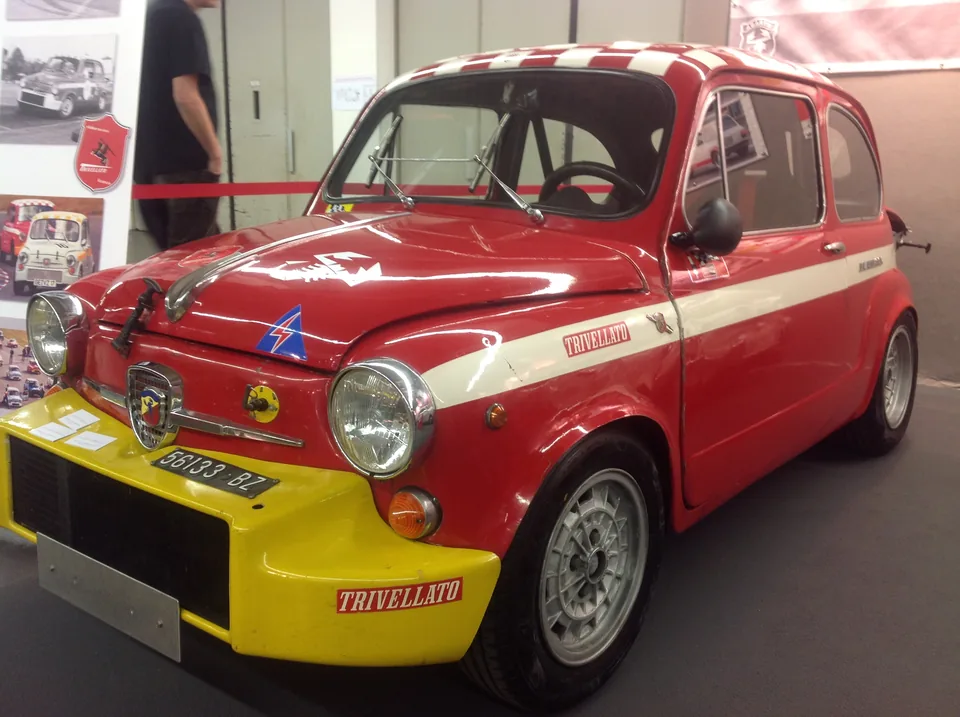
Fiat-Abarth 850 TC
Why 3.2: Abarth bored Fiat's 600-based twin out to 847cc and built exactly 1,000 examples in 1961 to satisfy touring-car homologation — the same recipe every small-bore Abarth on this shelf traces back to. It was a Nürburgring 500km and Spa-Francorchamps regular for most of the 1960s, and values have climbed roughly 25-fold since; most surviving cars now live in collections rather than club racing.
Layout
Natural habitat
Ride comfort
Sound
The lid stands open over an 847cc pushrod four and the radiator has moved forward, leaving nothing between the exhaust and the pit wall — the definitive small-saloon racing rasp. But it is coarse and stops at 6,500, below the twin-cam Abarths that followed.
4-cylinder · naturally aspirated · 6,500 rpm redline · rated 6.4 / 10 for engine sound
Market value
Median asking price, good condition · €2k (1961) → €41k (2026), trending up · illustrative data
Child seats · ISOFIX
Built before ISOFIX existed, so there are no anchor points at all. A child seat here is a seatbelt installation, and the belt geometry of the period was not designed with one in mind.
Derived from production years and seating layout, not a per-car source. ISOFIX was standardised as ISO 13216 in 1997, required on new EU model types from 2011 and on all new EU cars from 2014.
The long version
By 1960 Carlo Abarth had already spent a decade tuning other people's Fiats, and the 850 TC (Turismo Competizione) was the moment that expertise became a homologated racing product in its own right rather than a dealer-fit kit. The base was Fiat's own 600/850 saloon, unglamorous and cheap, with the rear-mounted twin bored and stroked from 767cc to 847cc and reworked for 52-57 hp depending on state of tune — enough to feel genuinely urgent in a car that weighed just 610 kg. Homologation for the FIA's touring-car category required 1,000 production examples, and Abarth built exactly that many inside 1961, then spent the rest of the decade watching the car rack up class wins at the Nürburgring 500km, the Spa-Francorchamps 24 Hours and dozens of smaller European touring-car rounds — a giant-killing reputation the later 1000 TCR would inherit and extend. For most of its life the 850 TC traded as cheap, slightly obscure Italian-saloon money, the kind of car club racers bought to actually use. That has changed: recent auction results cluster between $30,000 and $70,000, with the best-documented competition cars at the top of that range, and most surviving examples of the original 1,000 now live in collections rather than back on a circuit.