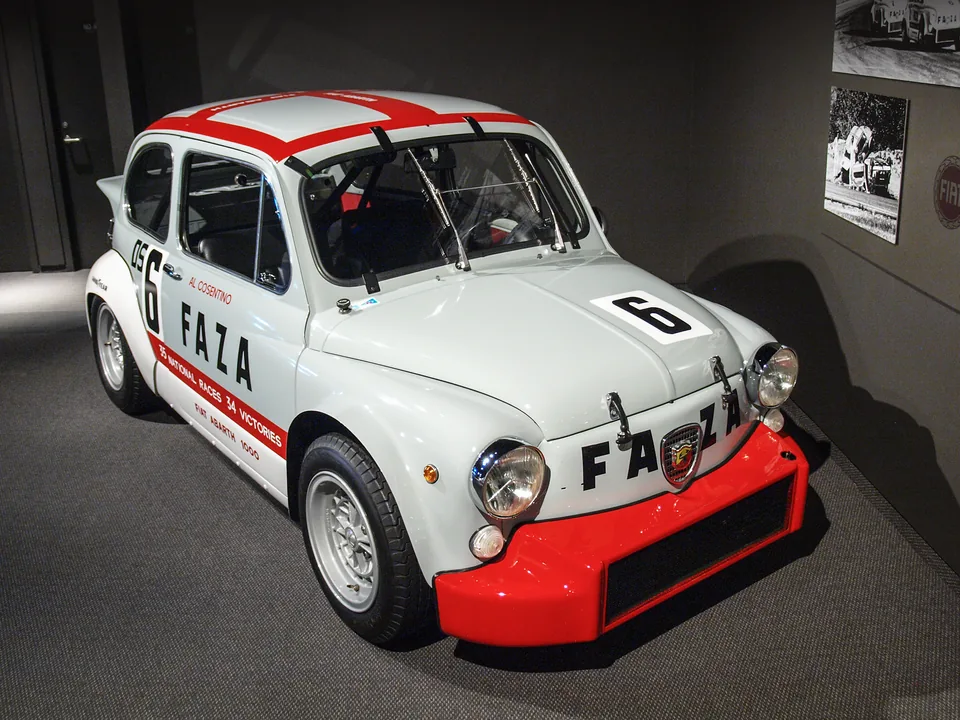
Fiat-Abarth 1000 TCR
Why 3.3: Abarth bored the Fiat 600's four to 982cc, fitted a Radiale cylinder head and dual Webers, and built a touring-car homologation special so effective it earned the nickname 'Giant Killer' for beating cars twice its size. Under 600 kg and revving hard, it belongs on a circuit more than a road — which is mostly where the survivors still are.
Layout
Natural habitat
Ride comfort
Sound
The radiale head is a pushrod hemi that spins past 8,000 with the engine lid vertical and effectively nothing behind it, which is why it was heard before it was seen. But it is a one-litre four, so the noise is shrill rather than substantial.
4-cylinder · naturally aspirated · 7,800 rpm redline · rated 7.0 / 10 for engine sound
Market value
Median asking price, good condition · €3k (1965) → €124k (2026), trending up · illustrative data
Child seats · ISOFIX
Built before ISOFIX existed, so there are no anchor points at all. A child seat here is a seatbelt installation in the only passenger seat there is.
Derived from production years and seating layout, not a per-car source. ISOFIX was standardised as ISO 13216 in 1997, required on new EU model types from 2011 and on all new EU cars from 2014.
The long version
Fiat's 600 was an economy car with a rear-mounted four-cylinder and nothing resembling sporting intent, which made it exactly the kind of unpromising base Carlo Abarth liked working from. The 1000 TC took the 600's engine out to 982cc; the TCR added Abarth's Radiale cylinder head — named for its radial valve arrangement — dual Weber carburetors and a five-speed gearbox, and the result weighed under 600 kg while making somewhere north of 100 hp depending on state of tune. Between 1962 and 1971 these small-bore Abarths won hundreds of races against nominally faster, far more powerful opposition, a habit that earned the whole family the 'Giant Killer' nickname in the touring-car paddock. One particularly potent example got an American SCCA driver, Alfred Cosentino, formally banned from running his radiale-headed engine because it was beating V8s in the wet. Almost nothing about the TCR was built for road use — the interior is a roll cage and a fuel cell where the rear bench used to be — and the surviving cars mostly still live that life, turning up at historic touring-car races and hillclimbs rather than road rallies. Values now range from roughly $50,000 for a straightforward example to well over $150,000 for a documented Radiale car, prices that track competition history as much as originality.