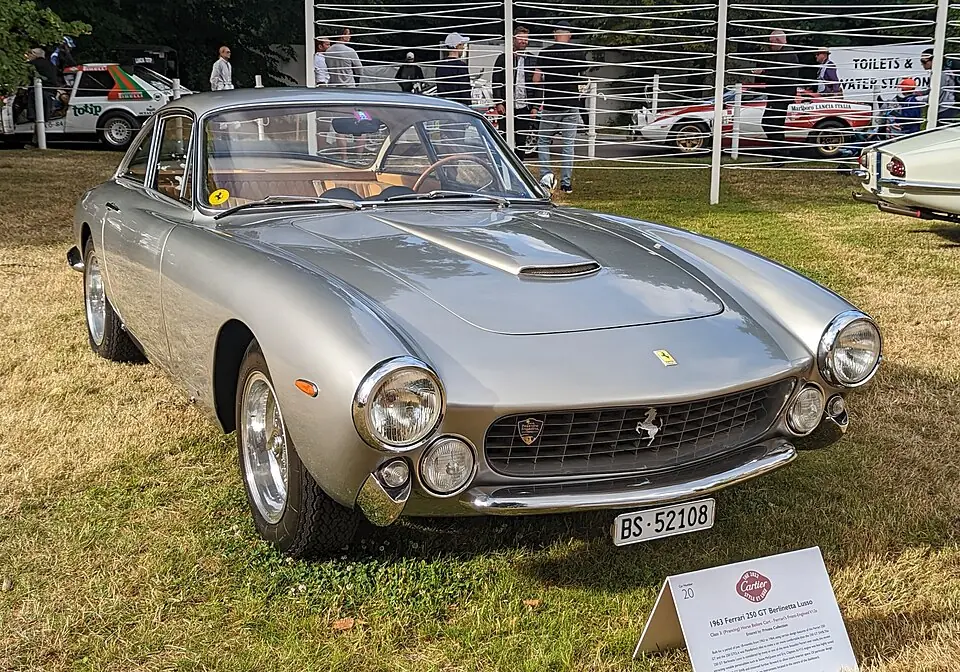
Ferrari 250 GT Lusso
Why 4.0: Doug's own scorecard gives the styling a perfect 10 and the acceleration a 1 — the Lusso was never about speed, and its DougScore 55 is built almost entirely on looks and cool factor. It's the rare blue-chip Ferrari that collectors still genuinely drive, a handful of times a year, at the vintage rallies this body was built for.
Layout
Natural habitat
Ride comfort
Sound
Three twin-choke Webers feeding a Colombo V12 to 7,500 rpm is the reference for what twelve cylinders should sound like, chain and cam noise included. But the Lusso is the touring 250, silenced for the road rather than a circuit, which holds it just off the top.
12-cylinder · naturally aspirated · 7,500 rpm redline · rated 9.2 / 10 for engine sound
Market value
Median asking price, good condition · €12k (1963) → €1.7M (2026), trending up · illustrative data
Child seats · ISOFIX
Built before ISOFIX existed, so there are no anchor points at all. A child seat here is a seatbelt installation in the only passenger seat there is.
Derived from production years and seating layout, not a per-car source. ISOFIX was standardised as ISO 13216 in 1997, required on new EU model types from 2011 and on all new EU cars from 2014.
The long version
The 250 GT Lusso was Ferrari's final word on the front-engine 250 line before the Daytona took over, a genuine road car rather than a homologation special, built in steel with disc brakes at all four corners and none of the competition pretense of the GTO it shared chassis lineage with. That distinction matters for how it's used today: this is one of the few seven-figure vintage Ferraris that still turns up at the Mille Miglia retrospective and the Tour Auto rather than sitting exclusively behind rope in a private collection, because the Lusso was built as a driver's grand tourer and the current ownership generation largely respects that brief. It isn't a daily proposition — insurance and irreplaceability keep annual mileage in the low hundreds for most owners — but the involvement is genuinely there when it does move: a 7,500rpm Colombo V12, an all-synchro manual, zero electronic assists between the driver and the road. Values spiked hard during the mid-2010s vintage-Ferrari bubble, corrected, and have resumed climbing since, the way blue-chip 250-series cars generally do.