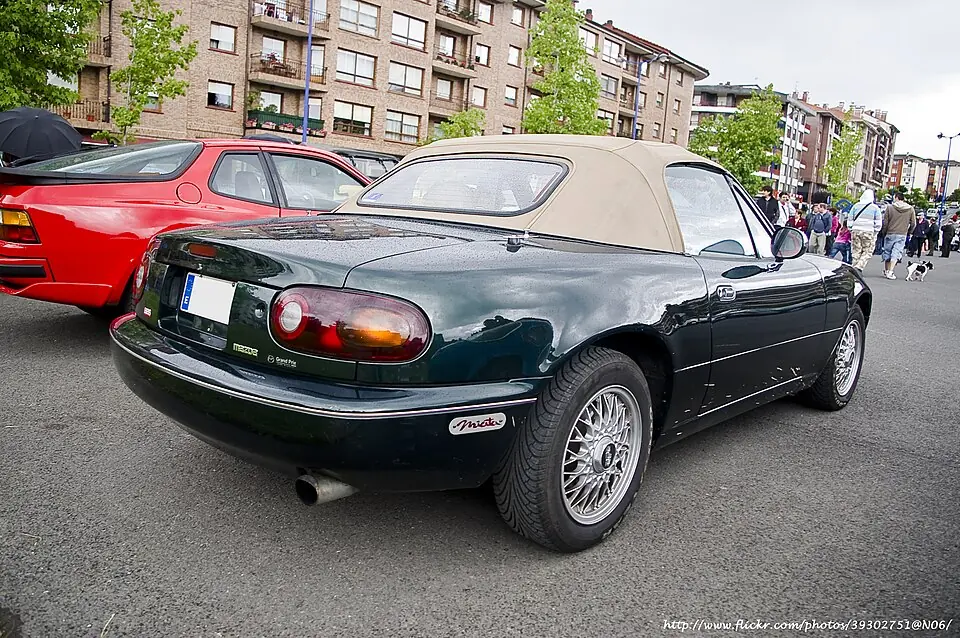
Mazda MX-5 (NA)
Why 7.3: Pop-ups, 950 kg, and thirty-five years of being driven to death and loved for it. Collector money circles the clean ones; the rest keep autocrossing.
Layout
Natural habitat
Ride comfort
Sound
A 1.6 twin-cam with the roof down and almost no insulation, so induction, exhaust and gearbox arrive as one thing. But 116 hp and 7,000 rpm make it a busy rasp rather than a note. The sound suits the car exactly and still does not rate highly.
4-cylinder · naturally aspirated · 7,000 rpm redline · rated 5.3 / 10 for engine sound
Market value
Median asking price, good condition · €5k (2000) → €17k (2026), trending up · illustrative data
Child seats · ISOFIX
There aren't any — strict two-seater.
NA Miata production ended in 1997, two years before ISO 13216-1 (the ISOFIX standard) was published in 1999 — the hardware didn't exist yet in any production car.
Backed by a 1990 factory manual's restraints chapter (seat belts and airbags only, no anchor hardware) plus the ISOFIX timeline — not a direct quote ruling it out for the later 1996-97 cars specifically.
Wikipedia (ISOFIX: ISO 13216-1 published 1999) + 1990 Mazda Miata factory manual (Restraints chapter) (owner-community sourced, not manufacturer documentation)
The long version
This is the car that started the affordable-roadster experiment the ND is still running today, and the habits haven't changed much across three decades — buy cheap, autocross on weekends, replace the top when it wears out, repeat. Pop-up headlights and a curb weight barely over 900 kg give the NA a cult following distinct from later generations, but parts interchange across the whole Miata lineage keeps even that nostalgia affordable to maintain. Clean, unmolested originals have started pulling collector money as the pop-up cars get scarcer, but most are still exactly what Mazda built them to be: cheap, disposable fun nobody feels guilty about using up.