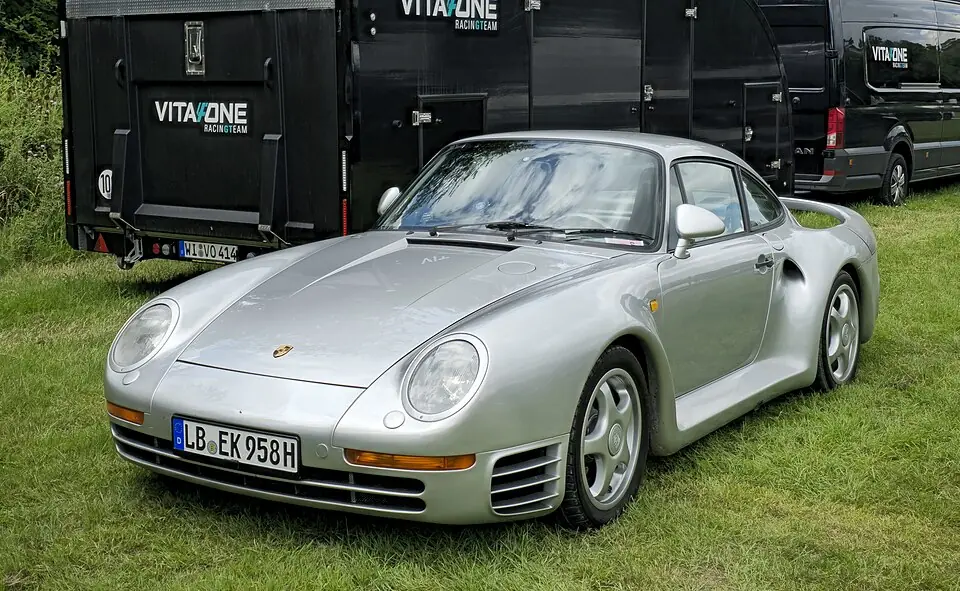
Porsche 959
Why 3.3: The AWD template every modern supercar copied, wrapped around a raw twin-turbo flat-six and a manual gearbox period reviewers called heavy and agricultural in the best way. Never federalized for US sale — the Show-or-Display imports that exist mostly sit, precisely because the electronically-managed all-wheel drive that made it famous also filtered the feel.
Layout
Natural habitat
Ride comfort
Sound
Sequential turbos on the 2.85 flat-six give a layered spool rather than one rush, and the cooling-fan whir is still there underneath. But the 959 was built as a refined GT, insulated and muted where a 930 is raw. Interesting to listen to rather than loud.
6-cylinder · turbocharged · 7,000 rpm redline · rated 6.8 / 10 for engine sound
Market value
Median asking price, good condition · €276k (2000) → €2M (2026), trending up · illustrative data
Child seats · ISOFIX
Built before ISOFIX existed, so there are no anchor points at all. A child seat here is a seatbelt installation in the only passenger seat there is.
Derived from production years and seating layout, not a per-car source. ISOFIX was standardised as ISO 13216 in 1997, required on new EU model types from 2011 and on all new EU cars from 2014.
The long version
Show-or-Display is the whole ownership story: the US cars exist under an exemption that caps them at 2,500 miles a year, and most don't get close. Collectors treat the 959 as the thinking person's counterpart to the F40 — bought for what it pioneered rather than for what it transmits, which is exactly backwards from how this site scores. The technology that stunned 1987 needs factory-classic specialists today, so even willing drivers ration miles around service anxiety. The result is a blue chip that appreciates in silence.