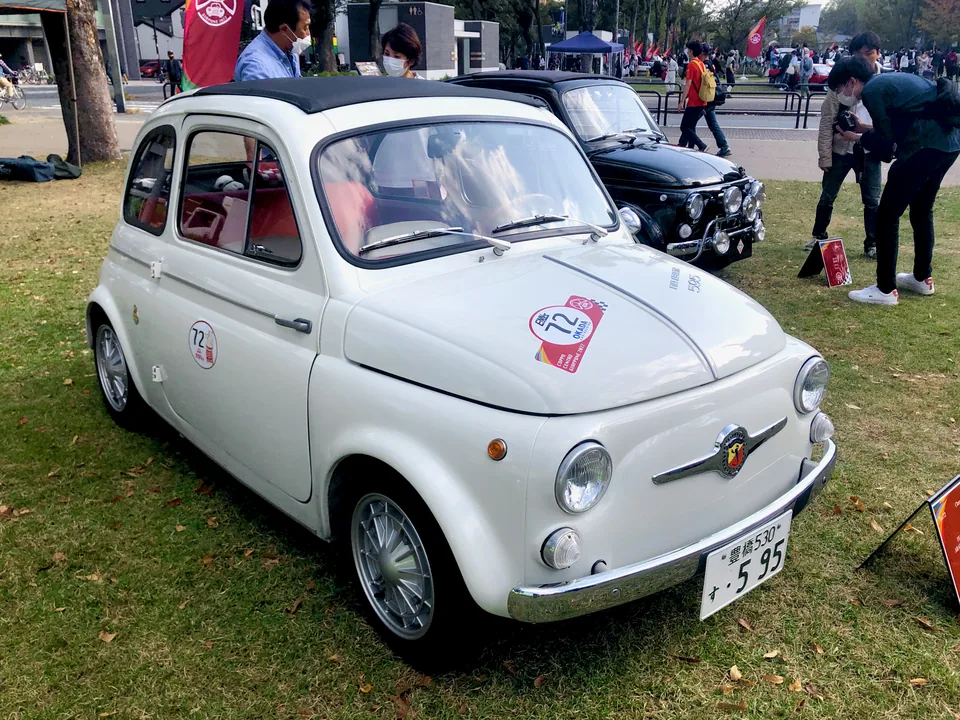
Fiat-Abarth 595
Why 3.8: Abarth bored the Fiat 500's air-cooled twin from 499cc to 594cc, added a bigger carburetor and a free-flowing exhaust, and sold the result as a factory-built performance 500 starting at the 1963 Turin show. It's the direct ancestor of the modern 595 Competizione elsewhere on this shelf, and at 500 kg it needed only 32 hp to feel quick.
Layout
Natural habitat
Ride comfort
Sound
An air-cooled 595cc twin with no water jacket to damp it and the engine lid propped open by design, which makes a thrash unlike anything else here. But two small cylinders at 6,500 rpm produce mechanical clatter more than a note.
2-cylinder · naturally aspirated · 6,500 rpm redline · rated 6.0 / 10 for engine sound
Market value
Median asking price, good condition · €1k (1963) → €26k (2026), trending up · illustrative data
Child seats · ISOFIX
Built before ISOFIX existed, so there are no anchor points at all. A child seat here is a seatbelt installation, and the belt geometry of the period was not designed with one in mind.
Derived from production years and seating layout, not a per-car source. ISOFIX was standardised as ISO 13216 in 1997, required on new EU model types from 2011 and on all new EU cars from 2014.
The long version
By the early 1960s Carlo Abarth had spent a decade building his reputation on exhaust systems and tuning kits for other people's cars, and the 595 was the moment that expertise turned into a factory-built product wearing his own badge on a Fiat showroom floor. The recipe was simple: take the 499cc twin from the ordinary Nuova 500, bore it out to 594cc, fit a bigger carburetor and an Abarth exhaust tuned for both noise and flow, and leave the rest of the car — all 500 kg of it — alone. The performance version briefly wore its own '595 SS' badge with 32 hp, enough to feel genuinely urgent in a car this light, and Fiat kept building them through two body updates, the round-taillight 500 D through 1965 and the 500 F after. Decades of cheap, plentiful Fiat 500 parts kept the 595 an accessible entry point into Italian classic ownership long after fancier exotics had left ordinary buyers behind, and it still shows up at historic rallies and Italian car club meets rather than sitting exclusively in collections. Values have moved up steadily rather than spiked — good examples now clear the mid five figures in dollars — proportionate appreciation for a car that was always meant to be driven, not admired from a rope line.