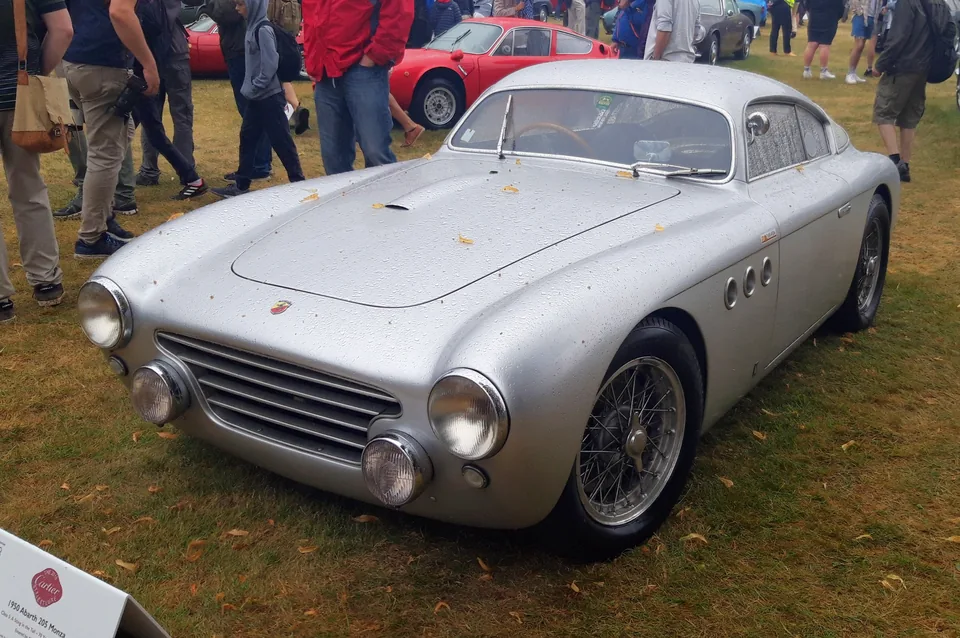
Abarth 205A Berlinetta
Why 1.7: The first car ever to wear the scorpion badge: a Vignale-bodied berlinetta over a tuned Fiat 1100B engine with a Cisitalia cylinder head, commissioned for a wealthy client and hand-built by Abarth's own fledgling company. Exactly three were made. One won its class on debut at the 1950 Coppa Intereuropa; today all three are museum-grade, effectively unobtainable, and almost never driven.
Layout
Natural habitat
Ride comfort
Sound
A tuned Fiat 1100 pushrod four with an open Abarth exhaust under a hand-formed Vignale body, loud out of all proportion to 66 hp. But 6,000 rpm and a pre-war-derived overhead-valve four give it effort rather than any real note.
4-cylinder · naturally aspirated · 6,000 rpm redline · rated 5.9 / 10 for engine sound
Market value
Median asking price, good condition · €4k (1950) → €414k (2026), trending up · illustrative data
Child seats · ISOFIX
Built before ISOFIX existed, so there are no anchor points at all. A child seat here is a seatbelt installation in the only passenger seat there is.
Derived from production years and seating layout, not a per-car source. ISOFIX was standardised as ISO 13216 in 1997, required on new EU model types from 2011 and on all new EU cars from 2014.
The long version
Before Abarth meant tuning kits for millions of Fiats, it meant this: a bespoke commission for a client wealthy enough to want a one-off Gran Turismo, and a brand-new company willing to build it from a blank chassis up. Carlo Abarth, fresh off the short-lived Cisitalia-Abarth 204A project, tasked Giovanni Michelotti at Vignale with the body — low, smooth, aluminum-skinned, with quad driving lights and a row of cooling louvers down each flank — while the mechanical side got a dry-sumped, heavily reworked Fiat 1100B four fitted with a Cisitalia-derived cylinder head, twin Weber carburetors and a Magneti Marelli magneto, good for roughly 65 hp in a car weighing just 818 kg. The first example was finished in March 1950 and entered the Coppa Intereuropa eleven days later, where co-owner Guido Scagliarini drove it to a class win; a 205A also appears in period photographs from that April's Mille Miglia. Only three were ever built, chassis 205-101 through 205-103, making this one of the rarest cars on the entire Index by a wide margin — rarer than the 1300 OT Periscopica's 50 cars, rarer than the 750 Record Monza's 100. Surviving examples now belong to serious historic collections and concours circuits; asking prices are essentially theoretical since the cars almost never change hands, and when they do it is a museum-to-museum transaction, not a purchase anyone is going to drive to the shops. It earns Valet Royalty honestly: the purest prestige object on the entire Abarth family tree, three cars that exist to be preserved as the literal beginning of the marque.