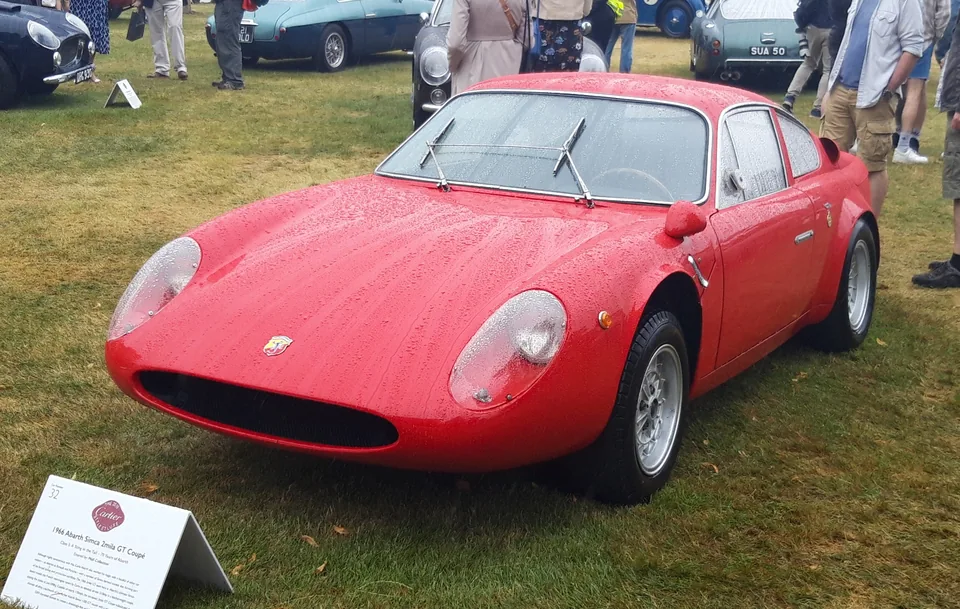
Abarth-Simca 2000 GT
Why 2.8: The Simca partnership's high-water mark: a 1,946cc four tuned to 204 hp at 7,200 rpm, stuffed into an aluminum-and-fiberglass body weighing barely 740 kg — a power-to-weight ratio that would embarrass plenty of modern hot hatches. Abarth built it to homologate a 2-liter GT racer; Chrysler's 1965 takeover of Simca ended the partnership before the formula went further.
Layout
Natural habitat
Ride comfort
Sound
An all-alloy twin-cam two-litre with twin-plug ignition and 58 mm Webers, unsilenced in a 740 kg body, which finally gives an Abarth four some depth. But a big four at 7,200 rpm is still hard and flat next to a proper six.
4-cylinder · naturally aspirated · 7,200 rpm redline · rated 7.5 / 10 for engine sound
Market value
Median asking price, good condition · €6k (1963) → €221k (2026), trending up · illustrative data
Child seats · ISOFIX
Built before ISOFIX existed, so there are no anchor points at all. A child seat here is a seatbelt installation in the only passenger seat there is.
Derived from production years and seating layout, not a per-car source. ISOFIX was standardised as ISO 13216 in 1997, required on new EU model types from 2011 and on all new EU cars from 2014.
The long version
Carlo Abarth's cooperation deal with Simca, signed in 1961, existed to do for the French manufacturer what he'd already done for a decade of Fiats — take a mainstream platform and extract a genuine competition car from it. The 2000 GT, unveiled at Geneva in March 1963, was the most extreme result: a 1,946cc four fed by huge 58mm Weber carburetors and tuned to 204 hp at 7,200 rpm, mounted low and aft in a body built from aluminum and fiberglass over a tube frame, the whole car weighing as little as 740 kg dressed. That combination was good for a genuine 168 mph, extraordinary for 1963, and the styling — a distinctive upswept tail acting as a built-in spoiler, courtesy of technical director Mario Colucci — was as purposeful as the mechanicals. Abarth's target was 100 cars, enough to homologate the 2000 GT for the 2-liter Gran Turismo class, and cars built to that standard went on to class wins at the Nürburgring, in the Swiss GT Championship and at hillclimbs across Europe through the mid-1960s. The partnership ended abruptly in 1965 when Chrysler took a controlling stake in Simca and had no interest in funding a low-volume Italian competition program; production stopped and Abarth redirected the same small-GT formula into cars like the OT 1300 that followed. Survivors are vanishingly rare today, split between static concours cars and a handful still campaigned in historic GT racing, and values track competition history and originality as closely as any car on this shelf.