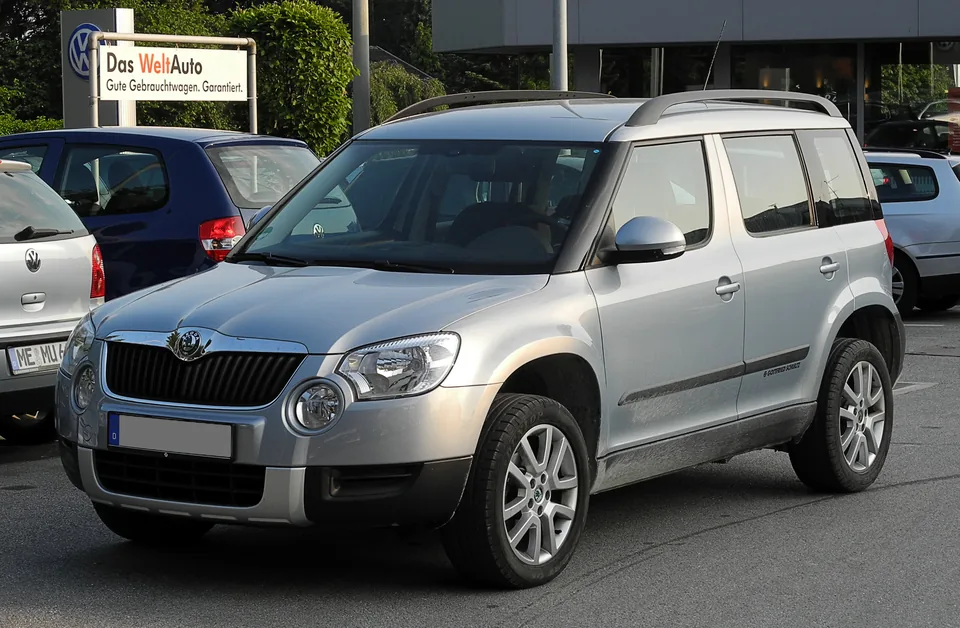
Škoda Yeti
Why 8.5: Škoda put an Octavia platform under a 4.22-metre upright box, gave it three individual rear seats that slide, fold and lift out altogether, offered a proper Haldex four-wheel-drive system with the 2.0 TDI, and then styled it like nothing else on sale. It was replaced in 2017 by the Karoq, which is better in every measurable way and which nobody talks about.
Layout
Natural habitat
Ride comfort
Sound
The 2.0 TDI thumps hard enough at low revs that you always know it is a diesel, and a tall, boxy cabin with a lot of flat glass resonates more than an Octavia does. That is the entire sonic event. Škoda spent nothing on the exhaust because nobody buying a Yeti asked, and they were right. Near the bottom of the combustion cars.
4-cylinder · turbocharged · 4,800 rpm redline · rated 3.0 / 10 for engine sound
Market value
Median asking price, good condition · €28k (2011) → €10k (2026), trending down · illustrative data
Child seats · ISOFIX
Two ISOFIX positions on the outer rear seats, the outer pair being the ones the standard covers.
The rear anchors are the supported route — the manual points child seats there, and front-passenger ISOFIX is the exception rather than the rule. A belt-mounted seat up front needs the airbag off, and cars with a rear row don't always fit a deactivation switch, precisely because the rear seats exist.
Derived from production years and seating layout, not a per-car source. ISOFIX was standardised as ISO 13216 in 1997, required on new EU model types from 2011 and on all new EU cars from 2014.
The long version
The Yeti is the strongest argument this index can make that ownership satisfaction and objective quality are different things. Mechanically it is a Golf Mk5 platform in a tall body — 1.2 to 1.8 TSI petrol engines, 1.6 and 2.0 TDI diesels, front drive or a Haldex-coupled four-wheel-drive system on the bigger engines — and by 2016 the underpinnings were a decade old. What it had instead was packaging nobody else bothered with: a genuinely upright glasshouse you could see out of, three separate rear seats that slid, reclined, folded flat or came out of the car entirely, and dimensions small enough to park. It won Top Gear magazine's Family Car of the Year in 2009 and then quietly became the car that owners' surveys kept putting first, year after year, for reasons that had nothing to do with pace. Around 798,000 were built between 2009 and 2017 and the ownership pattern is the one this index rewards: bought new by families and small businesses, run for eight or ten years at 15,000 km a year, then sold to somebody who wanted a Yeti specifically and not a crossover in general. Residuals stayed unusually strong for a mainstream Volkswagen Group product, and when the Karoq replaced it — quieter, faster, better finished, and with a fixed rear bench — a measurable number of owners simply kept the old one. Škoda has never sold a car in the United States, which is its own kind of loss here.