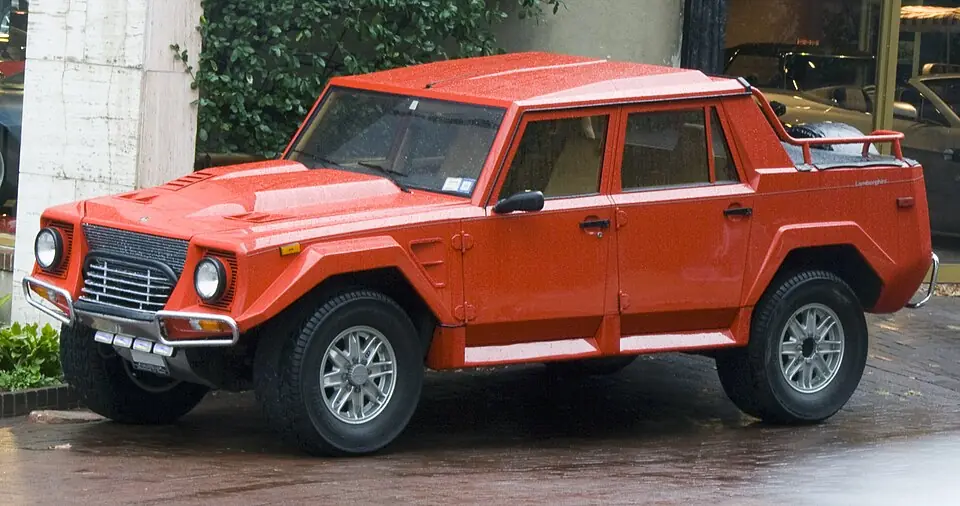
Lamborghini LM002
Why 3.3: The engine is the Countach's 5.2-liter V12, dropped into a ladder-frame truck with unassisted everything and zero electronic aids — genuinely raw by any measure, not a costume. Chassis fidelity is the weak lens: live axles and a high center of gravity blunt what the drivetrain promises, capping the number below where the powertrain alone would put it.
Layout
Natural habitat
Ride comfort
Sound
A carburetted Countach V12 with six Webers, and the induction noise alone puts it beyond any other truck ever built. But it is geared and silenced for two and a half tonnes of off-roader, so it almost never reaches the revs where a Countach comes alive.
12-cylinder · naturally aspirated · 6,500 rpm redline · rated 7.5 / 10 for engine sound
Market value
Median asking price, good condition · €110k (1990) → €506k (2026), trending up · illustrative data
Child seats · ISOFIX
Built before ISOFIX existed, so there are no anchor points at all. A child seat here is a seatbelt installation, and the belt geometry of the period was not designed with one in mind.
Derived from production years and seating layout, not a per-car source. ISOFIX was standardised as ISO 13216 in 1997, required on new EU model types from 2011 and on all new EU cars from 2014.
The long version
Lamborghini built this before the SUV-for-oligarchs playbook existed, developing it from a rejected military prototype and then, almost as an afterthought, dropping in the same V12 doing duty in the contemporary Countach. Most of the roughly 300 built went to buyers who wanted the badge and the presence more than a genuine off-roader, but a real minority used the four-wheel-drive hardware as intended, including desert testing that fed back into the car's development. Values sat flat for decades before a recent wave of Lamborghini-collector interest rediscovered it, pulling surviving trucks out of driveways and into protected collections.