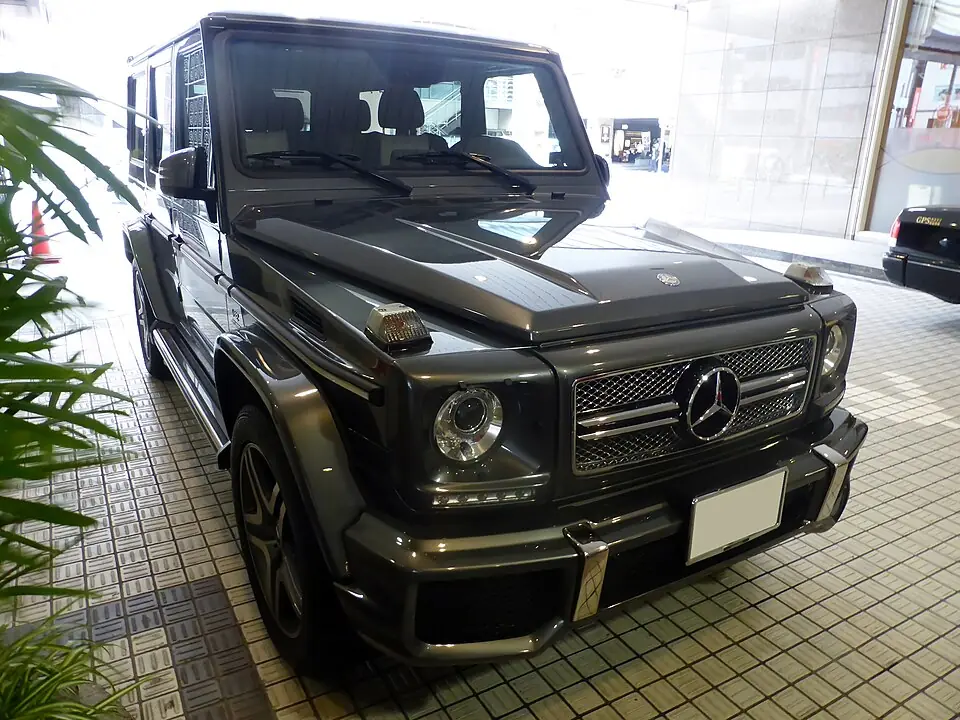
Mercedes-AMG G 65
Why 3.3: Same solid-axle G-Wagen the V8 G63 uses, for another $80k and a V12 that adds mass more than it adds anything you can feel from the driver's seat. Bought almost entirely for what the badge signals, not for anything the V12 does that the V8 doesn't.
Layout
Natural habitat
Ride comfort
Sound
Side-exit pipes running down a boxy G's flanks put the noise right beside you, and the twin-turbo V12 rumbles heavily at idle. But 6,000 rpm, two turbochargers and truck gearing mean it never does anything above a walk — theatre from the pipes, not from the engine.
12-cylinder · turbocharged · 6,000 rpm redline · rated 5.8 / 10 for engine sound
Market value
Median asking price, good condition · €201k (2016) → €212k (2026), trending up · illustrative data
Child seats · ISOFIX
Two ISOFIX securing rings on the outer second-row seats, plus top tether.
No ISOFIX on the front passenger seat — Mercedes' G-Class manual limits the anchors to the second row across all W463 trims.
Mercedes-Benz G-Class owner's manual (ManualsLib)
The long version
Mercedes sold the G65 as the ultimate G-Wagen almost entirely on the strength of the number twelve, since the chassis underneath — solid front and rear axles, a ladder frame, dynamics that were dated when the G-Class launched decades earlier — does not meaningfully improve over the cheaper G63's twin-turbo V8. Early cars traded well above sticker in some markets purely on scarcity and badge value, the clearest possible signal that the buyer pool was speculating on exclusivity rather than shopping on driving merit. The V12's extra weight over the front axle makes an already nose-heavy, tall-riding truck even less composed, which is precisely why this index scores it below its V8 sibling despite the bigger number on the spec sheet. It is the purest badge-flex purchase in the G-Wagen lineup, and the used market's flattening premium over the G63 is the market finally agreeing.