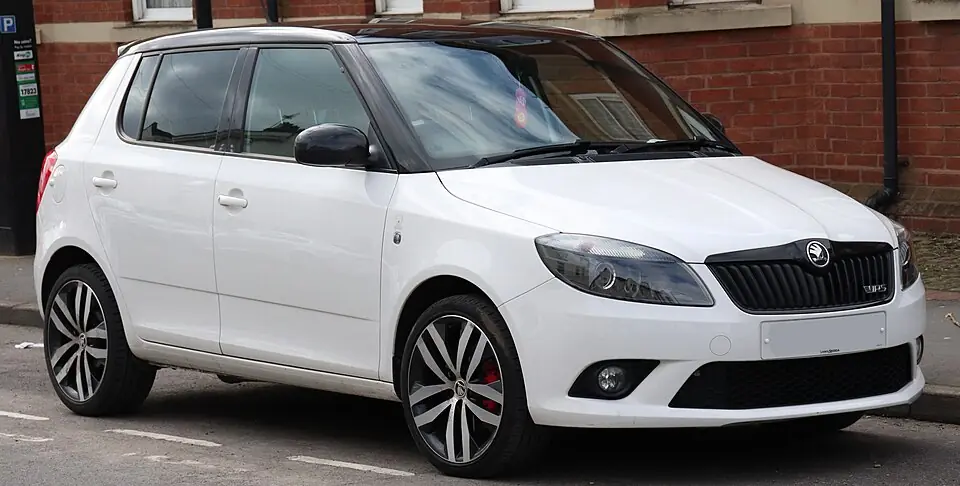
Škoda Fabia vRS (Mk2)
Why 8.2: A twincharged 1.4 doing 180 hp through a DSG-only gearbox, in a wagon-adjacent hatchback nobody expects to be quick. The no-manual policy kept the purists away and left the car to buyers who just wanted a fast, cheap Skoda and didn't need to row their own gears.
Layout
Natural habitat
Ride comfort
Sound
The twincharged 1.4 does one thing nothing else here does: you hear the supercharger whine below 2,400 rpm before the turbo takes the handover. But the engine is tiny and thoroughly muffled and the DSG shifts before anything builds. The whine is the only event.
4-cylinder · turbocharged · 6,500 rpm redline · rated 5.0 / 10 for engine sound
Market value
Median asking price, good condition · €20k (2011) → €9k (2026), trending down · illustrative data
Child seats · ISOFIX
The same report states plainly that "the presence of ISOFIX anchorages in the rear outboard seats was not clearly marked" — a labelling complaint, not an absence; the ratings note it applies across the range.
Euro NCAP's Fabia report discusses only a front-passenger airbag cut-off switch enabling a belted rearward-facing seat — it never mentions a front ISOFIX anchorage, in direct contrast to its explicit callout of the rear ones. Switch existing is not evidence of a front anchor.
NCAP tested the pre-facelift 1.2 Sport in 2007; the vRS is the 2010 facelift of the same generation, so this should carry over, but the vRS's own front sport seat isn't separately confirmed.
Euro NCAP Škoda Fabia (2007) assessment report
The long version
Škoda borrowed the Volkswagen Group's twincharged 1.4 — supercharged for low-end response, turbocharged for the top end, a genuinely clever piece of engineering VW abandoned a few years later for a simpler single turbo — and put 180 hp through a DSG-only gearbox in a hatchback that still looked like sensible Škoda transportation. The no-manual policy cost it some purist credibility, the same complaint leveled at the Polo GTI of the same era, but it left the car to buyers who wanted genuine pace without rowing their own gears, and those buyers have generally kept and used the cars rather than flipped them. It never sold in the US — Škoda has not been in the American market since the 1990s — so it is Forbidden Fruit by default, known here mostly to people who cross-shopped it against a Fiesta ST or a Polo GTI while living in Europe. Values dropped hard through the 2010s and have mostly stayed down, the unglamorous curve of a car whose badge never carried any speculative premium.