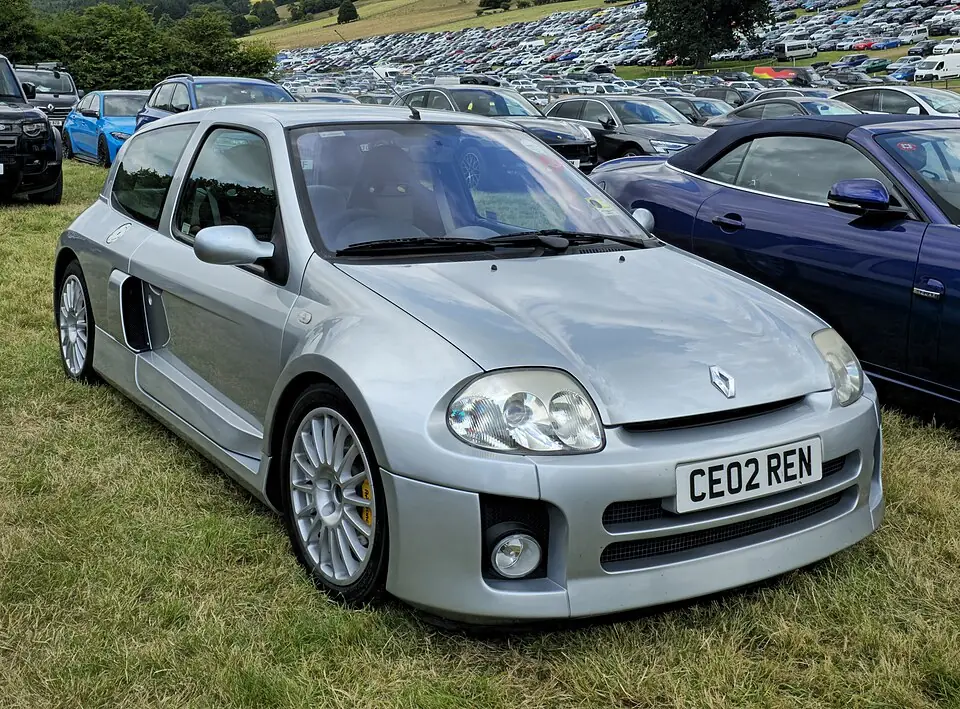
Renault Clio V6
Why 4.0: Renault put a V6 where the shopping used to go, snap-oversteer included. Collector prices ended its hooligan era; the brave still drive them properly.
Layout
Natural habitat
Ride comfort
Sound
The 3.0 V6 sits where the back seats were, so induction, cam gear and exhaust all arrive from a foot behind your neck with nothing in between. But the engine itself is an ordinary Renault unit revving to 7,100. Placement does almost all the work, and it works.
6-cylinder · naturally aspirated · 7,100 rpm redline · rated 7.2 / 10 for engine sound
Market value
Median asking price, good condition · €23k (2005) → €83k (2026), trending up · illustrative data
Child seats · ISOFIX
There aren't any — strict two-seater.
The only position there is — and the weak point of this era. Airbag cut-off switches only became routine in the mid-2000s; many of these cars have none from the factory, which rules out a rear-facing seat entirely unless a dealer-fitted deactivation was installed. Forward-facing on the belt, seat slid fully back, is what the period manuals allow.
Derived from production years and seating layout, not a per-car source. ISOFIX was standardised as ISO 13216 in 1997, required on new EU model types from 2011 and on all new EU cars from 2014.
The long version
Never sold in the US, so import buyers are only now reaching the 25-year mark on the earliest examples, and what they're importing has a reputation for snapping into oversteer without much warning — a car that filters its own ownership pool by scaring off anyone not fully committed. Values have climbed hard as collector interest in Renault's most unhinged hot-hatch experiment grew, which makes the shrinking group still willing to drive one properly genuinely notable; most cars this expensive and this twitchy get parked instead. The ones still being driven are being driven by people who knew exactly what they bought.