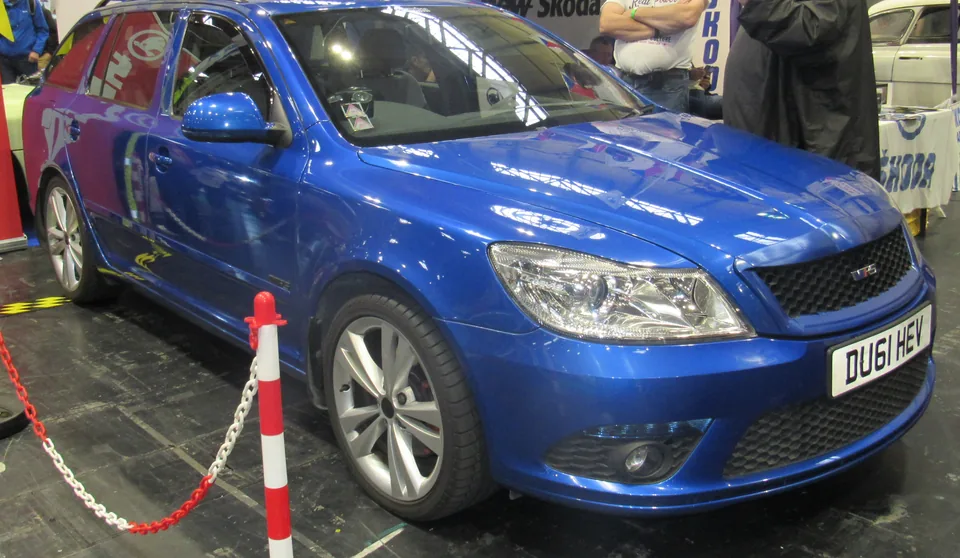
Škoda Octavia vRS TDI (Mk2)
Why 8.6: The same 2.0 TDI that made the rest of Europe's fleet cars dull, turned up to 170 PS and 350 Nm and dropped into a car with Golf GTI suspension geometry and a 580-litre boot. It costs Fabia money to run and will outpace most warm hatches between roundabouts, which is exactly why nobody who has one wants a Golf.
Layout
Natural habitat
Ride comfort
Sound
Škoda gave the vRS a freer exhaust and a deeper idle than a fleet Octavia, which is more effort than anyone else spent trying to make a 2.0 TDI sound like something. It failed. This is a common-rail four with a particulate filter, thoroughly muffled and finished by 4,800 rpm. The torque is the reward, not the noise.
4-cylinder · turbocharged · 4,800 rpm redline · rated 3.1 / 10 for engine sound
Market value
Median asking price, good condition · €28k (2010) → €6k (2026), trending down · illustrative data
Child seats · ISOFIX
Two ISOFIX positions on the outer rear seats, the outer pair being the ones the standard covers.
The rear anchors are the supported route — the manual points child seats there, and front-passenger ISOFIX is the exception rather than the rule. A belt-mounted seat up front needs the airbag off, and cars with a rear row don't always fit a deactivation switch, precisely because the rear seats exist.
Derived from production years and seating layout, not a per-car source. ISOFIX was standardised as ISO 13216 in 1997, required on new EU model types from 2011 and on all new EU cars from 2014.
The long version
The Octavia vRS has always been the Volkswagen Group's least flattering product, in the sense that it makes the more expensive cars in the family look badly priced. The Mk2 sat on the same PQ35 platform as the Golf Mk5, used the same suspension hardware, and was available with either the 200 PS 2.0 TFSI petrol or — the one Europe actually bought — the 170 PS 2.0 TDI, with 350 Nm arriving at 1,750 rpm and a real-world 45 to 50 mpg to go with it. On paper the diesel is the slower car. In use, on a British B-road or a German Landstraße, the difference is close to nothing, and the diesel does it while covering 900 km between fills with a family and their luggage on board. That is why the ownership pattern is what it is. This car was bought by people doing 40,000 km a year who wanted something quick that would not bankrupt them, and it has been used accordingly: 300,000 km examples are common, and the ones that survive have usually had a clutch, a dual-mass flywheel and a set of injectors along the way. Škoda has not sold a car in the United States since the 1990s, so like the Fabia vRS above it in the rail this is Forbidden Fruit almost by accident — not withheld, simply never on offer. Values bottomed out years ago and have stayed there, which means anyone buying one now is buying it to drive it into the ground, again.