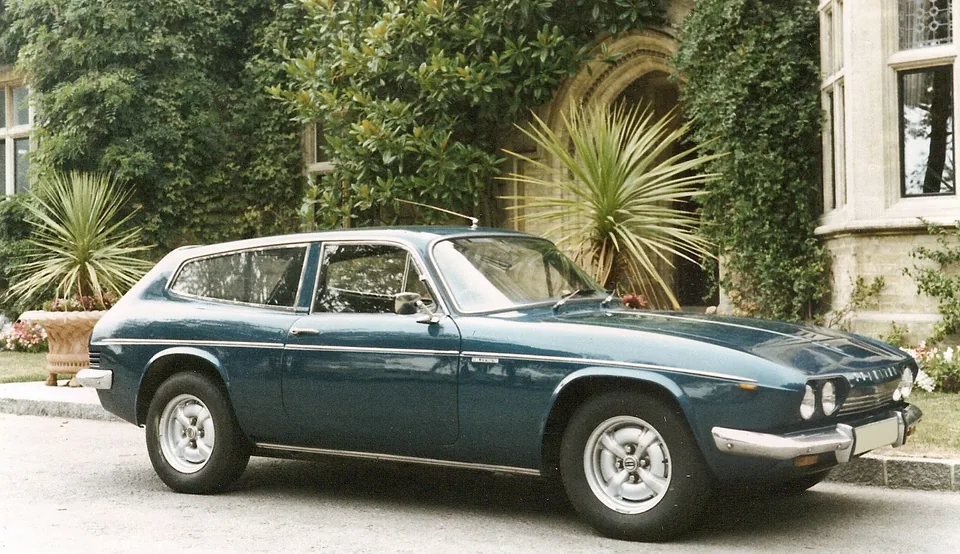
Reliant Scimitar GTE
Why 7.0: Tom Karen at Ogle Design put a glass tailgate and folding rear seats on a sporting coupe in 1968 and effectively invented the genre the Volvo P1800ES, the BMW Z3 M Coupé and every fast estate since have been working in. Underneath: a Ford Essex 3.0 V6, a steel box-section chassis and a fibreglass body that cannot rust.
Layout
Natural habitat
Ride comfort
Sound
The Ford Essex V6 is a 60-degree engine with an off-beat, hard-edged burble neither the Cologne V6 that replaced it nor any straight-six reproduces, and a glassfibre body insulates almost nothing. But it is a pushrod engine out of ideas by 5,500 rpm, and the overdrive exists to keep it quiet. Character rather than music.
6-cylinder · naturally aspirated · 5,500 rpm redline · rated 6.5 / 10 for engine sound
Market value
Median asking price, good condition · €5k (1970) → €20k (2026), trending up · illustrative data
Child seats · ISOFIX
Built before ISOFIX existed, so there are no anchor points at all. A child seat here is a seatbelt installation, and the belt geometry of the period was not designed with one in mind.
Derived from production years and seating layout, not a per-car source. ISOFIX was standardised as ISO 13216 in 1997, required on new EU model types from 2011 and on all new EU cars from 2014.
The long version
Reliant is remembered for three-wheeled vans, which makes the Scimitar GTE one of the odder things in British motoring: a company best known for the Robin also built, years ahead of everyone else, the first properly resolved sporting estate. The GTE arrived in 1968 with a Ford Essex V6, 135 bhp, overdrive on the top two ratios and a glassfibre body over a steel box-section chassis — light, quick enough for the period, and genuinely practical in a way no other car with that shape was. Princess Anne was given one for her twentieth birthday in November 1970 and went on to own nine of them, which did more for the model's profile in Britain than any advertising campaign could have. Around 14,200 GTEs were built across the SE5, SE5A, SE6, SE6A and SE6B series before Reliant switched to the smaller Ford Cologne V6 and then stopped in 1986. It was never federalised for the United States, so the car that arguably created the shooting brake as a mainstream idea is almost unknown in the market that later bought the most of them. What keeps it high here rather than in classic-asset territory is the ownership culture: the body does not rot, the running gear is Ford, the owners' club is unusually competent, and values have stayed low enough that nobody buys one as an investment. They get driven to club meetings and used for holidays, which is what they were built for.