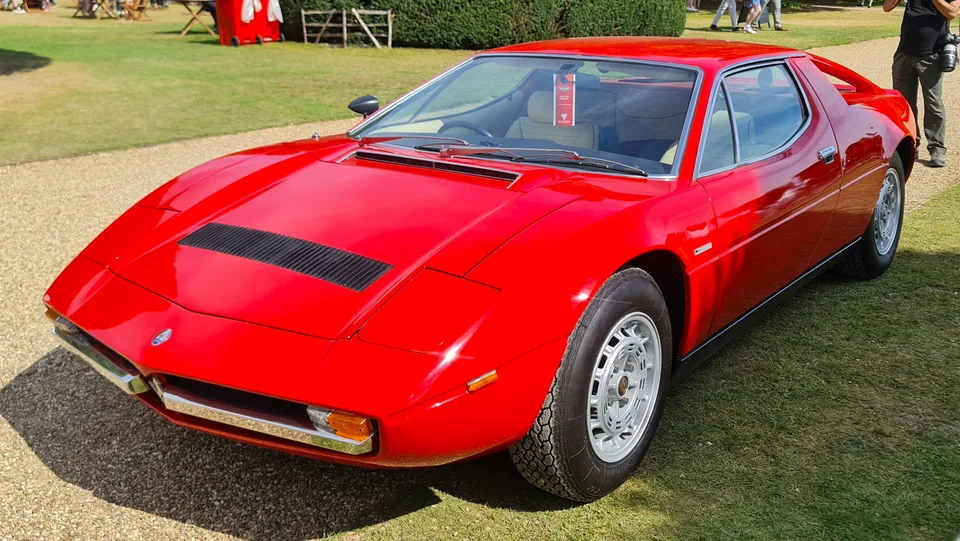
Maserati Merak
Why 4.4: Not a smaller Bora — a different car sharing its nose. The quad-cam 3.0 V6 is the engine Giulio Alfieri designed for the Citroën SM, the gearbox is Citroën's own transaxle, and the rear is left open between two flying buttresses instead of glazed over. Two extra seats and about 1,830 built against the Bora's 524.
Layout
Natural habitat
Ride comfort
Sound
A quad-cam Maserati V6 on three Webers, behind a thin bulkhead with two token rear seats between it and your ears — harder and more metallic than any Dino V6, nothing like the Bora's V8 bark. But six cylinders cannot reach the Bora's depth and it runs out at 6,500 rpm. Exotic, and smaller than the badge suggests.
6-cylinder · naturally aspirated · 6,500 rpm redline · rated 7.4 / 10 for engine sound
Market value
Median asking price, good condition · €21k (1975) → €60k (2026), trending up · illustrative data
Child seats · ISOFIX
Built before ISOFIX existed, so there are no anchor points at all. A child seat here is a seatbelt installation, and the belt geometry of the period was not designed with one in mind.
Derived from production years and seating layout, not a per-car source. ISOFIX was standardised as ISO 13216 in 1997, required on new EU model types from 2011 and on all new EU cars from 2014.
The long version
Citroën owned Maserati when both of these cars were designed, and the Merak is the more thoroughly French of the two. Its V6 began life as the 2.7-litre Tipo C.114 that Alfieri drew for the Citroën SM; the five-speed transaxle behind it is Citroën's; early left-hand-drive cars got the SM's oval-gauge dashboard more or less unaltered, and the same hydropneumatic circuit that runs an SM's brakes runs the Merak's. Giugiaro's Bora bodywork was reused from the windscreen forward, but behind the cabin the roofline is carried back as two open buttresses with nothing between them — the quickest way to tell the two apart at a glance, and the reason the Merak has a pair of occasional rear seats where the Bora has a glass engine cover. It was cheaper new and it sold better: roughly 1,830 Meraks across three engine specifications against 524 Boras. For most of the last forty years it has also been the affordable one, the Maserati you could buy for the price of a used saloon on the understanding that finding somebody to service Citroën hydraulics inside an Italian mid-engined car was your problem. That is what separates it from the Bora here — more cars, lower prices, more owners who actually drove them, and a slower climb into collector territory. The climb is happening now, which is what keeps the score where it is rather than higher.