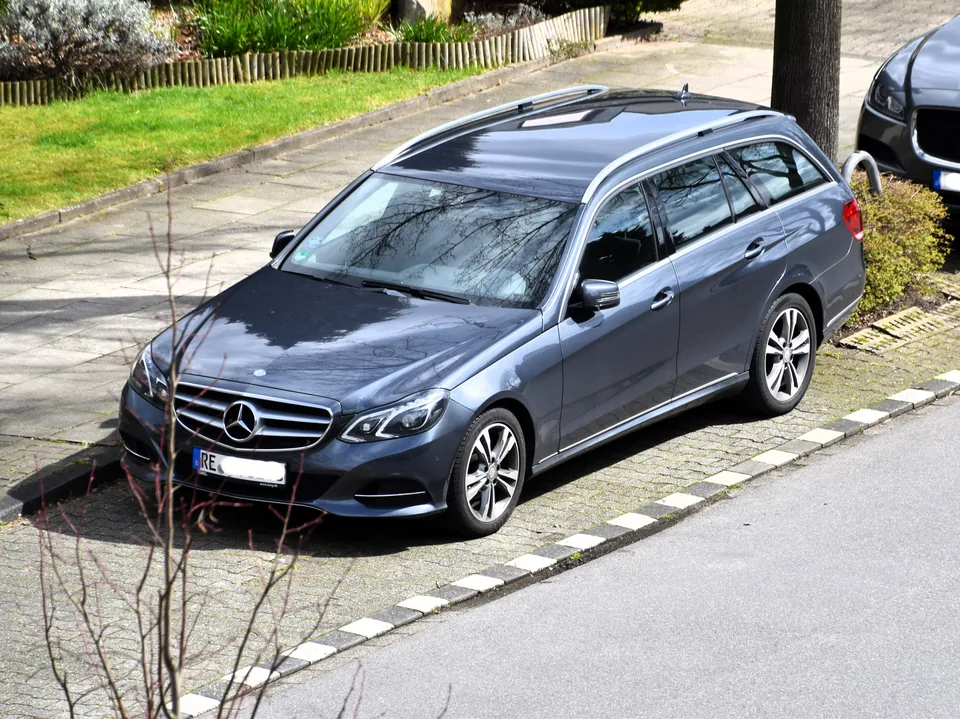
Mercedes-Benz E 300 BlueTEC Estate (S212)
Why 8.9: A 3.0-litre V6 diesel with 231 hp and 540 Nm from 1,550 rpm, seven ratios, rear-wheel drive and 1,950 litres behind the front seats. It is not fast, it is not interesting, and it will do 250,000 km of autobahn while returning 6 l/100 km — which is why German fleets bought them by the thousand and nobody has ever flipped one.
Layout
Natural habitat
Ride comfort
Sound
The OM642 is a compact 72-degree V6, with a smoother, deeper thrum under load than any four-cylinder diesel Mercedes sold beside it. But the S212 was engineered so you would not notice the engine at all — acoustic glass, an encapsulated bay, peak torque at 1,550 rpm — and it is done by 4,600. Silence was the brief.
6-cylinder · turbocharged · 4,600 rpm redline · rated 3.4 / 10 for engine sound
Market value
Median asking price, good condition · €63k (2014) → €18k (2026), trending down · illustrative data
Child seats · ISOFIX
Two ISOFIX positions on the outer rear seats, the outer pair being the ones the standard covers.
The rear anchors are the supported route — the manual points child seats there, and front-passenger ISOFIX is the exception rather than the rule. A belt-mounted seat up front needs the airbag off, and cars with a rear row don't always fit a deactivation switch, precisely because the rear seats exist.
Derived from production years and seating layout, not a per-car source. ISOFIX was standardised as ISO 13216 in 1997, required on new EU model types from 2011 and on all new EU cars from 2014.
The long version
The OM642 is the engine that carried Mercedes through the decade: a compact 72-degree V6 diesel used in everything from the Sprinter to the Grand Cherokee, and in the S212 estate it is doing exactly the work the OM617 did in a W123 forty years earlier, with an extra 143 hp and an extra 450 Nm. In facelift form from March 2013 the E 300 BlueTEC made 170 kW — 231 PS — with 540 Nm available from 1,550 rpm, driving the rear wheels through the 7G-Tronic automatic, and it will sit at 180 km/h all day and still average better than 40 mpg doing it. That is the entire proposition and it is enough. These went to German company-car fleets, to Austrian and Swiss families who tow, and to the taxi ranks that have taken every large Mercedes diesel since the fifties, and they accumulate distance at a rate almost nothing else on this index matches: 300,000 km is unremarkable, 500,000 km happens. The trade-off is that nobody wants one afterwards. Depreciation on a big diesel estate has been brutal since the 2015 emissions reckoning, low-emission-zone rules have made European city ownership harder, and a car that cost €58,000 new can be bought for the price of a used Polo. There is no collector interest and there never will be. The people who own them now own them because a 1,845 kg rear-drive estate with 540 Nm and a boot that swallows a wardrobe is still the most useful car anyone has built, and they intend to keep driving it until it stops.