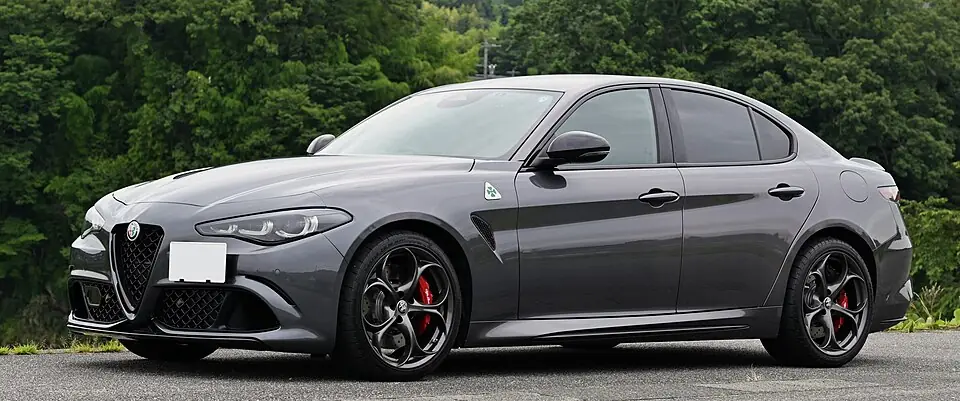
Alfa Romeo Giulia Quadrifoglio
Why 7.8: Nobody cross-shops a Quadrifoglio — you either get it or you buy the German one. The people who get it drive it hard and keep it long, depreciation be damned.
Layout
Natural habitat
Ride comfort
Sound
The 2.9 twin-turbo six is hard and metallic and genuinely revs to 7,300, further than any rival super-saloon engine, and the exhaust cracks properly on the overrun. But two turbochargers still stand between you and the induction, and there is a Busso in the family history.
6-cylinder · turbocharged · 7,300 rpm redline · rated 7.3 / 10 for engine sound
Market value
Median asking price, good condition · €63k (2018) → €40k (2026), trending down · illustrative data
Child seats · ISOFIX
Both rear outboard seats have standard ISOFIX, verified via Euro NCAP's 2016 child-occupant testing.
No ISOFIX at the front passenger position — inferred from the Stelvio's Euro NCAP datasheet, since Giulia and Stelvio share the same 'Giorgio' platform and cabin architecture; Giulia's own datasheet wasn't directly accessible to confirm independently.
A front-passenger airbag cut-off switch is standard on the Stelvio; treat as likely-but-unconfirmed on Giulia given the shared platform.
Euro NCAP (Stelvio sibling-platform datasheet; Giulia inferred) (owner-community sourced, not manufacturer documentation)
The long version
Alfa's reliability reputation does some of the buyer-screening work before the car even gets bought; anyone put off by the idea of Italian electronics has already self-selected out, leaving an ownership base that is genuinely committed rather than accidental. Values have fallen more than a third since 2018, and the used buyers arriving through that Bargain Window tend to be the same type as the original owners: people who wanted the Ferrari-derived V6 badge more than resale security. It shows up in the mileage data too, high use, low flip rate, because nobody buying a used Quadrifoglio at a discount is doing it to park it.