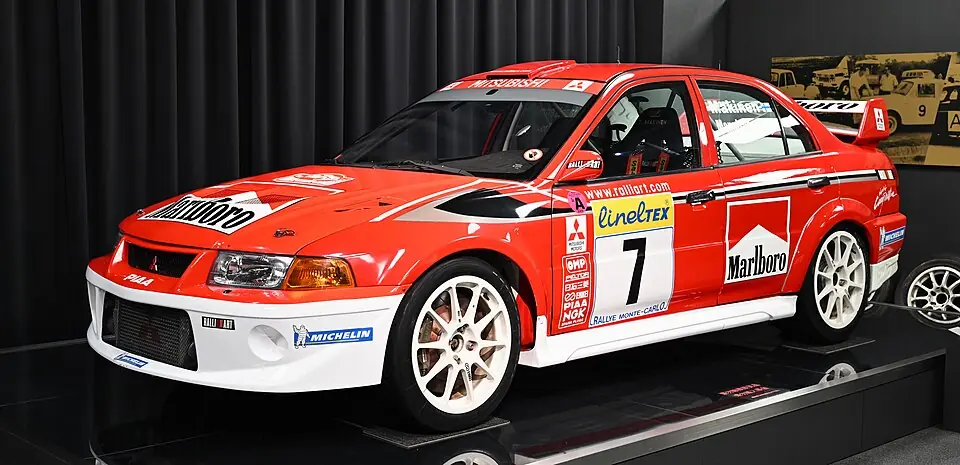
Mitsubishi Lancer Evo VI
Why 4.3: Four WRC titles baked into a rental-grade sedan shell. The Mäkinen cars crossed into collector territory and stopped seeing gravel; the rest still get driven like Mitsubishi intended.
Layout
Natural habitat
Ride comfort
Sound
The 4G63 makes the authentic Group A noise: spool, wastegate chatter and a hard thrash to 7,000 rpm. But there is no boxer offbeat to give it an identity and the turbo swallows the top end, so it is a rally soundtrack rather than an engine note — just above the Integrale.
4-cylinder · turbocharged · 7,000 rpm redline · rated 5.8 / 10 for engine sound
Market value
Median asking price, good condition · €23k (2005) → €74k (2026), trending up · illustrative data
Child seats · ISOFIX
ISOFIX was spreading through these years rather than fitted across the board — whether a given car has rear anchors depends on its year and market.
Children were expected in the back. Front-passenger ISOFIX effectively didn't exist in this era, and airbag deactivation was patchy — treat the front seat as a no unless a specific car proves otherwise.
Derived from production years and seating layout, not a per-car source. ISOFIX was standardised as ISO 13216 in 1997, required on new EU model types from 2011 and on all new EU cars from 2014.
The long version
Mitsubishi never federalized this for the US, so the entire domestic population arrived either through the 25-year import window or as a genuinely risky earlier gray-market job, and that filtering process alone explains why the buyer pool skews toward people who researched the car for years before they could legally own one. Values have more than tripled since 2005, steepest in the last five years as import eligibility widened, and the Tommi Makinen editions specifically have pulled away from the regular Evo VI on both price and how rarely they are driven. Flip Bait and Forbidden Fruit both describe a market that trades the car more readily than it rallies it.