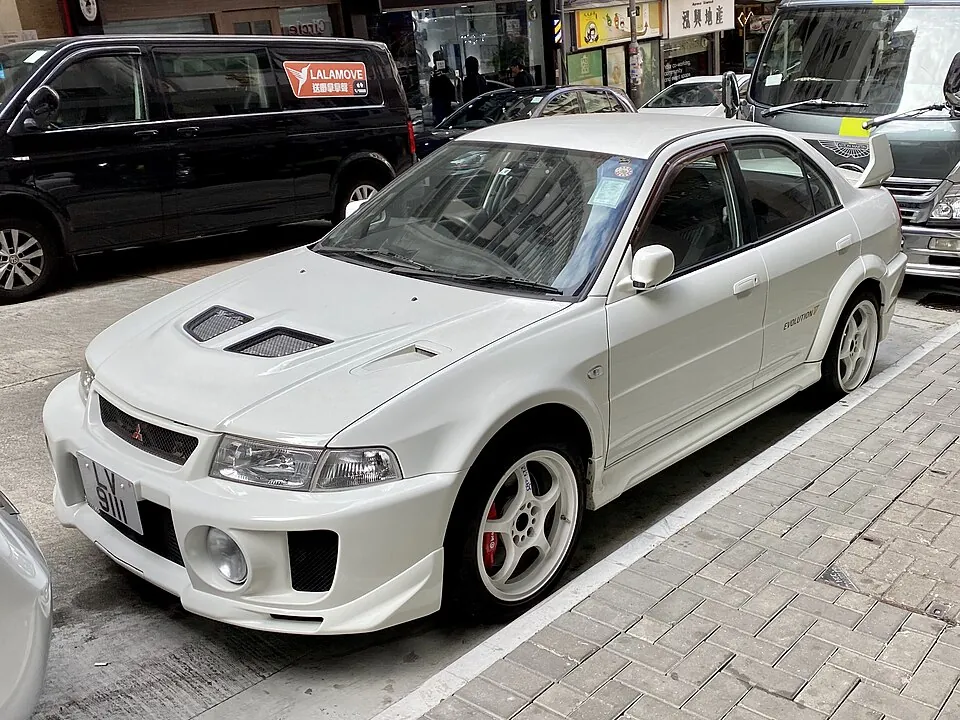
Mitsubishi Lancer Evolution IV/V
Why 6.4: The IV introduced Active Yaw Control, which shuffles torque across the rear axle to rotate the car, and the V widened the body past the Japanese class limit for 17-inch wheels, Brembo brakes and a wider track. Tommi Mäkinen took his third and fourth drivers' titles in this era. None of it was ever sold new in America.
Layout
Natural habitat
Ride comfort
Sound
The 4G63 is a hard, mechanical four with a big turbo whistling over it and an audible dump valve, which is exactly the rally soundtrack the homologation promises. It has none of the boxer's off-beat signature, so it sits below the Subarus on character.
4-cylinder · turbocharged · 7,000 rpm redline · rated 5.8 / 10 for engine sound
Market value
Median asking price, good condition · €28k (1998) → €57k (2026), trending up · illustrative data
Child seats · ISOFIX
ISOFIX was spreading through these years rather than fitted across the board — whether a given car has rear anchors depends on its year and market.
Children were expected in the back. Front-passenger ISOFIX effectively didn't exist in this era, and airbag deactivation was patchy — treat the front seat as a no unless a specific car proves otherwise.
Derived from production years and seating layout, not a per-car source. ISOFIX was standardised as ISO 13216 in 1997, required on new EU model types from 2011 and on all new EU cars from 2014.
The long version
The fourth and fifth Evolutions are where the recipe hardened. The Evo IV of 1996 moved to the new Lancer shell, turned the engine around, fitted a twin-scroll turbocharger and introduced Active Yaw Control — a rear differential that can send more torque to the outside wheel and physically steer the car with the throttle, years before anyone else shipped the idea. The Evo V of 1998 abandoned the narrow Japanese 5-number tax class altogether so the arches could grow, giving it a wider track, 17-inch wheels, Brembo brakes and the adjustable rear wing that became the visual signature of the whole line. All of it existed to homologate the works rally car, and it worked: Tommi Mäkinen won the drivers' championship in 1998 and Mitsubishi took the manufacturers' title the same year. Mitsubishi did not sell any Evolution in the United States until the VIII arrived in 2003, so these are import-only cars there, and the combination of scarcity, rally provenance and a rising 1990s Japanese market has pushed clean examples well past what they cost new. They are still used, though — hillclimbs, sprints and stage rallies are full of them.