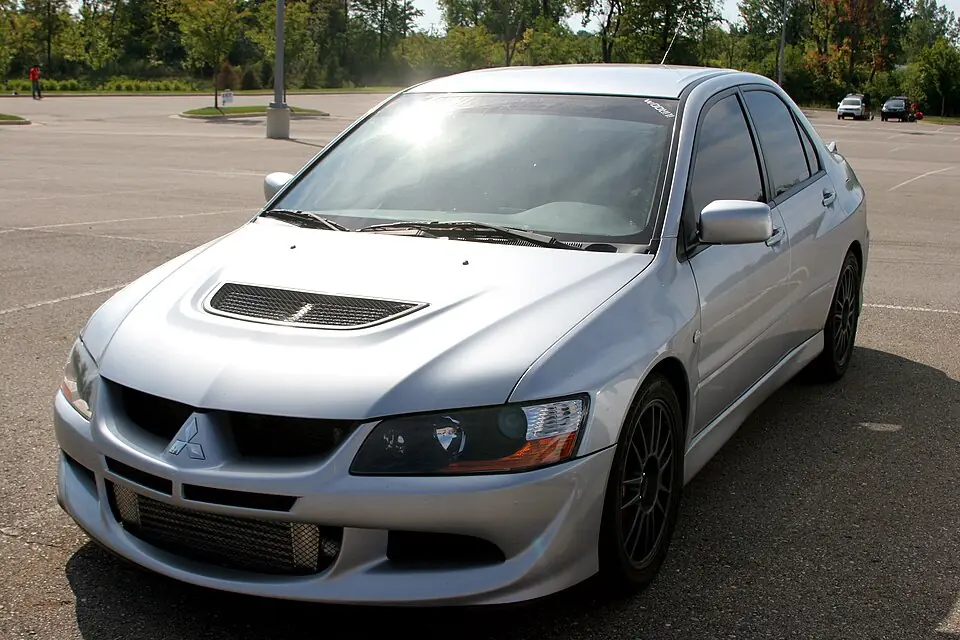
Mitsubishi Lancer Evolution VIII/IX
Why 5.3: The 4G63 turbo four and AYC-driven AWD carried straight over from the JDM-only VI, detuned and insulated for US emissions and comfort. A decade of ramen-budget tuning thinned the unmolested herd; what's left now commands real money.
Layout
Natural habitat
Ride comfort
Sound
The iron-block 4G63 has a hard, gruff rasp with the rally-derived spool and blow-off chatter that go with it. But it is a muffled two-litre four with none of the boxer's off-beat signature, and the turbo covers the top end. Between the Integrale and the 22B.
4-cylinder · turbocharged · 7,000 rpm redline · rated 5.9 / 10 for engine sound
Market value
Median asking price, good condition · €28k (2004) → €39k (2026), trending up · illustrative data
Child seats · ISOFIX
A BeSafe/Stokke ISOFIX vehicle-compatibility list codes the contemporaneous Mitsubishi Lancer (2003, same Cedia-based CS platform as Evo VIII/IX) as ISOFIX positions "2,4" — the two rear outboard seats only.
No front ISOFIX documented; the base Lancer this generation shares its bodyshell with does not list a front position either.
Sourced via the base Lancer CS platform the Evo VIII/IX shares, not an Evolution-badge-specific listing.
BeSafe iZi Go ISOFIX car list (Mitsubishi Lancer 2003: positions 2,4) (owner-community sourced, not manufacturer documentation)
The long version
This was the first Evo Americans could buy from a dealer instead of an importer, and the buyer pool at launch skewed exactly how you'd expect: twenty-somethings financing a rally-bred sedan on a tuner budget, then promptly reflashing the ECU and swapping the turbo. That decade of hard use thinned the stock population fast, so the unmolested survivors now command money nobody paid attention to a decade ago, doubling in the last five years alone. The modified majority is still priced like a used Lancer and still gets driven exactly like one — snow, track days, commutes, all of it.