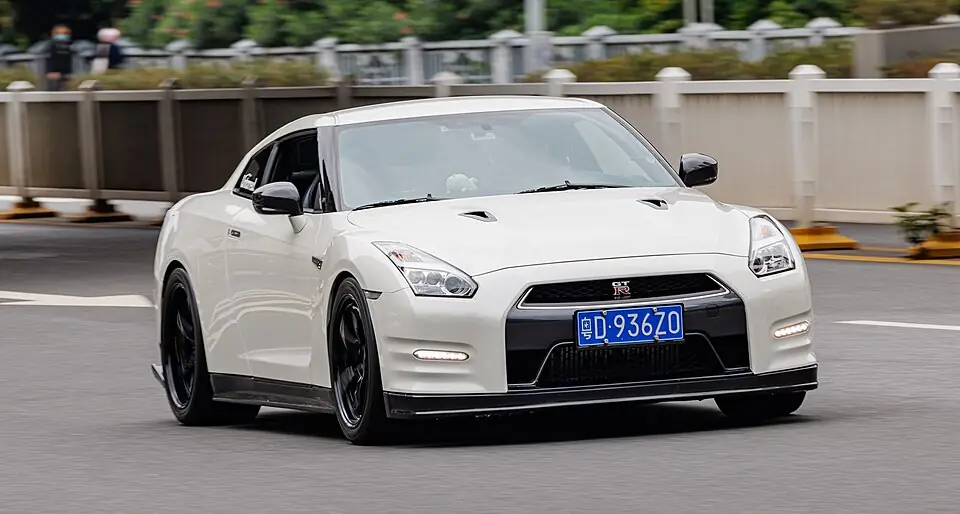
Nissan GT-R (R35)
Why 5.3: Launch-control legend that democratized supercar pace. Production ended and the collector clock started — early cars still get driven, late Nismos get vaulted.
Layout
Natural habitat
Ride comfort
Sound
What you actually hear is the rear transaxle whining and the turbos spooling, a combination distinctive enough to be part of the car's appeal. But the VR38 itself is a muffled twin-turbo V6, and a gearbox doing the talking is not the same as an engine note.
6-cylinder · turbocharged · 7,000 rpm redline · rated 5.9 / 10 for engine sound
Market value
Median asking price, good condition · €69k (2010) → €101k (2026), trending up · illustrative data
Child seats · ISOFIX
Both rear jump seats get LATCH lower anchors (what Nissan's manual calls the ISOFIX-compatible system) plus two top-tether points on the parcel shelf, standard across the range.
No LATCH lower anchors on the front passenger seat. The owner's manual only allows a forward-facing restraint there via the seatbelt, and explicitly bars rear-facing restraints from the front seat entirely.
LATCH is rated only up to 65 lb (29.5 kg) combined child+seat weight — above that Nissan requires the seatbelt instead of the lower anchors.
2019 Nissan GT-R US owner's manual
The long version
Early R35s landed with a generation that wanted a video-game supercar it could actually launch-control off a stoplight, and plenty still get taken to the drag strip on a Saturday because that's the whole point of owning one. The last Nismos are a different buyer entirely — bought in the final model years specifically because the run was ending, insured for storage more than use. Production stopped in 2024 and prices have climbed steadily since, pulling even the harder-used earlier cars toward the same protect-the-asset thinking that already governs the Nismos.