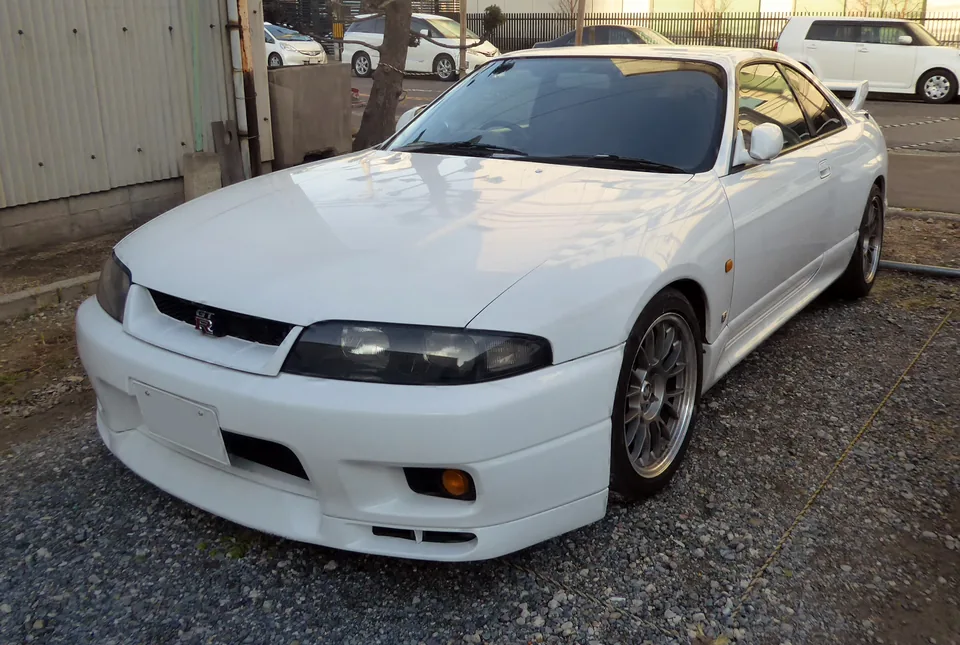
Nissan Skyline GT-R (R33)
Why 6.5: The same RB26DETT and ATTESA E-TS four-wheel drive as the R32, on a body 105 mm longer in the wheelbase and about 100 kg heavier — which most people decided they disliked before driving it. Nissan's counter-argument was a 7:59.887 lap of the Nürburgring, the first sub-eight-minute time claimed for a production car.
Layout
Natural habitat
Ride comfort
Sound
The RB26DETT is worth hearing for the induction and twin-turbo spool alone, and it holds together cleanly all the way to 8,000 rpm. But Nissan silenced the standard exhaust heavily, and the turbos take off the hard straight-six edge.
6-cylinder · turbocharged · 8,000 rpm redline · rated 6.8 / 10 for engine sound
Market value
Median asking price, good condition · €41k (1995) → €110k (2026), trending up · illustrative data
Child seats · ISOFIX
ISOFIX was spreading through these years rather than fitted across the board — whether a given car has rear anchors depends on its year and market.
Children were expected in the back. Front-passenger ISOFIX effectively didn't exist in this era, and airbag deactivation was patchy — treat the front seat as a no unless a specific car proves otherwise.
Derived from production years and seating layout, not a per-car source. ISOFIX was standardised as ISO 13216 in 1997, required on new EU model types from 2011 and on all new EU cars from 2014.
The long version
The R33 sits between two icons and has been paying for it for thirty years: the R32 won Group A everywhere it raced and the R34 got the films and the video games, while the R33 grew, gained weight and looked heavier still. What the extra length actually bought was stability — it is the easiest of the three to drive quickly, and the V-spec added ATTESA E-TS Pro with an active rear differential to sharpen the point. Nissan built 16,668 of them across four years and sold none new in the United States; a run of 97 V-specs officially imported to Britain in 1997 is the only export programme the car ever had. Being the unloved one kept prices below the R32 and far below the R34 for the entire period, and that is precisely why R33s get used: it is still bought by someone who wants a GT-R to drive rather than an appreciating asset, even as the wider Skyline market drags it upward. Modification rates are high, so the cars now commanding real money are the standard ones — the same inversion the 240SX and the Supra went through a decade earlier.