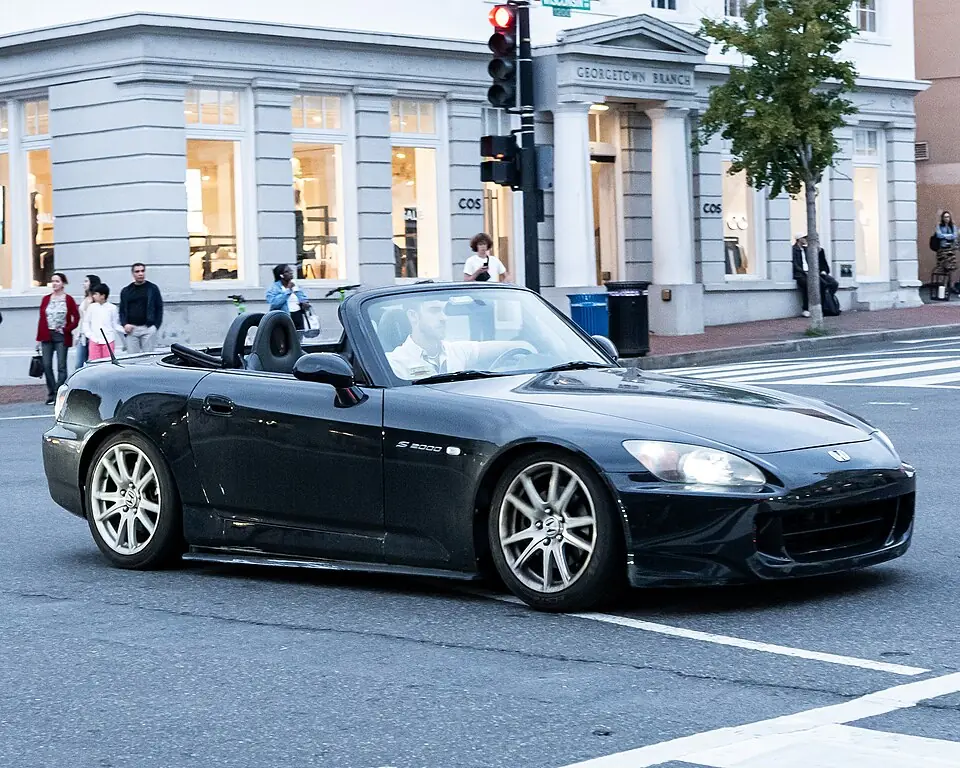
Honda S2000
Why 7.3: A 9,000 rpm four, a perfect shifter and nothing else. Owners rack up miles because the car is only alive above 6,000 rpm — appreciation hasn't scared them off yet.
Layout
Natural habitat
Ride comfort
Sound
Four cylinders have no business sounding like this: the F20C pulls to 9,000 rpm and changes character completely as VTEC engages. It ranks this high for revs and drama rather than depth — there is only so much a 2.0 four can do below 6,000.
4-cylinder · naturally aspirated · 9,000 rpm redline · rated 8.8 / 10 for engine sound
Market value
Median asking price, good condition · €24k (2005) → €51k (2026), trending up · illustrative data
Child seats · ISOFIX
There aren't any — strict two-seater.
No factory child-seat anchors of any kind. Honda's own manual only describes lap/shoulder-belt installation, and Honda does not recommend fitting a child seat in the S2000 at all.
Owners who need a front child seat typically go through NHTSA's dealer-installed airbag on-off-switch program for vehicles with no rear seat — there's no such switch as standard equipment.
Honda 2004 S2000 owner's manual (child-seat installation section) + S2KI/Honda-Tech owner forum consensus
The long version
Values have roughly doubled since the mid-2010s trough, exactly the point in a car's life where owners usually start parking it for weekend photo ops, and the S2000 crowd mostly has not gotten the memo. Forums stay full of track-day writeups and daily-commute threads rather than concours prep, because the car only rewards you once you are using the top half of the tach, and buyers who wanted a static investment picked something else entirely. Smiles per Dollar and Screamer both point at the same fact: bought for the engine note at 8,000 rpm, not for what it might be worth in five years.