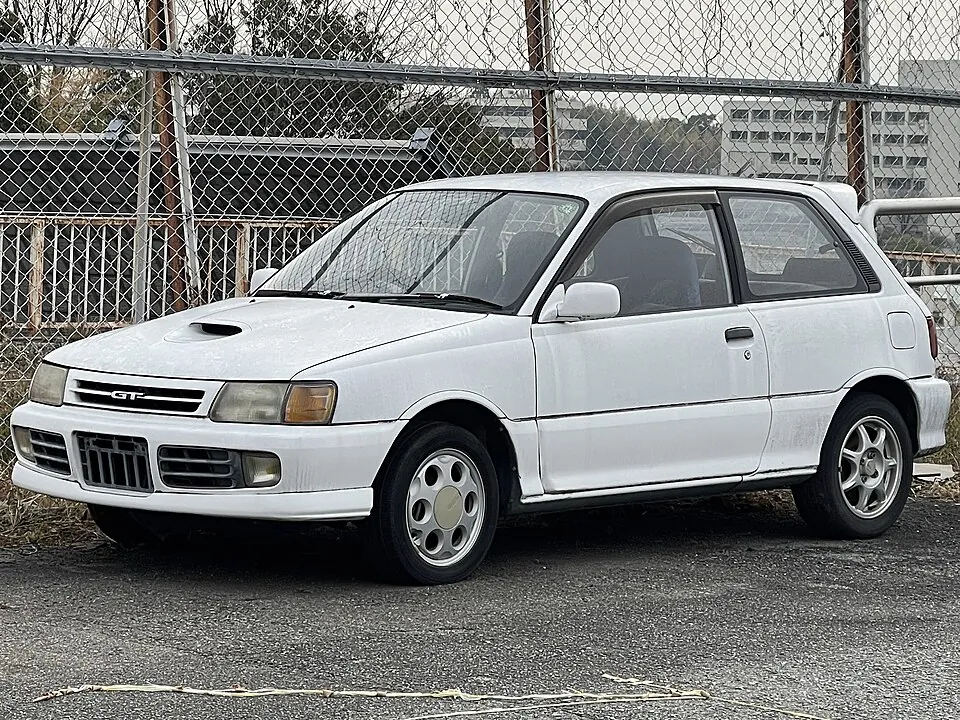
Toyota Starlet GT Turbo
Why 7.7: Toyota put a turbocharger and an intercooler on a 1,331 cc four, left the car at 930 kg and sold it only in Japan. 135 PS sounds like nothing until you divide it by the weight — and the later EP91 Glanza V added five more. Cheap enough for decades that almost every survivor has been modified, thrashed, or both.
Layout
Natural habitat
Ride comfort
Sound
A 1.3 with a turbo strapped to it makes a comically disproportionate whistle, and at 930 kg nothing muffles it. But the 4E-FTE is a thrashy economy four with nothing underneath the boost, so the theatre belongs to the turbo and not the engine.
4-cylinder · turbocharged · 7,000 rpm redline · rated 4.7 / 10 for engine sound
Market value
Median asking price, good condition · €12k (1992) → €16k (2026), trending up · illustrative data
Child seats · ISOFIX
ISOFIX was spreading through these years rather than fitted across the board — whether a given car has rear anchors depends on its year and market.
Children were expected in the back. Front-passenger ISOFIX effectively didn't exist in this era, and airbag deactivation was patchy — treat the front seat as a no unless a specific car proves otherwise.
Derived from production years and seating layout, not a per-car source. ISOFIX was standardised as ISO 13216 in 1997, required on new EU model types from 2011 and on all new EU cars from 2014.
The long version
The Starlet GT Turbo is the small end of Toyota's late-eighties confidence: a supermini with a 1,331 cc twin-cam four, a CT9 turbocharger, an air-to-air intercooler and 135 PS, in a body weighing about 930 kg. The gearing is short, the boost arrives early, and because the whole car is so light it will still embarrass much more powerful machinery on a tight road. Toyota sold the P80 Starlet widely in Europe but kept the GT Turbo for Japan alone, and the United States had already lost the Starlet nameplate entirely in 1984 — so the turbo car never had an official chapter in either market. Britain and Ireland ended up with a large grey-import population, which is where much of its reputation was made and where a lot of them were destroyed: these were the cheap tuning platform of the late nineties, and a great many were boosted well past what the standard internals wanted. The EP91 Glanza V that replaced it in 1996 is essentially the same idea with a softer face and 140 PS. Good original cars have become genuinely rare and expensive, but the ones still on the road are being used, not stored.