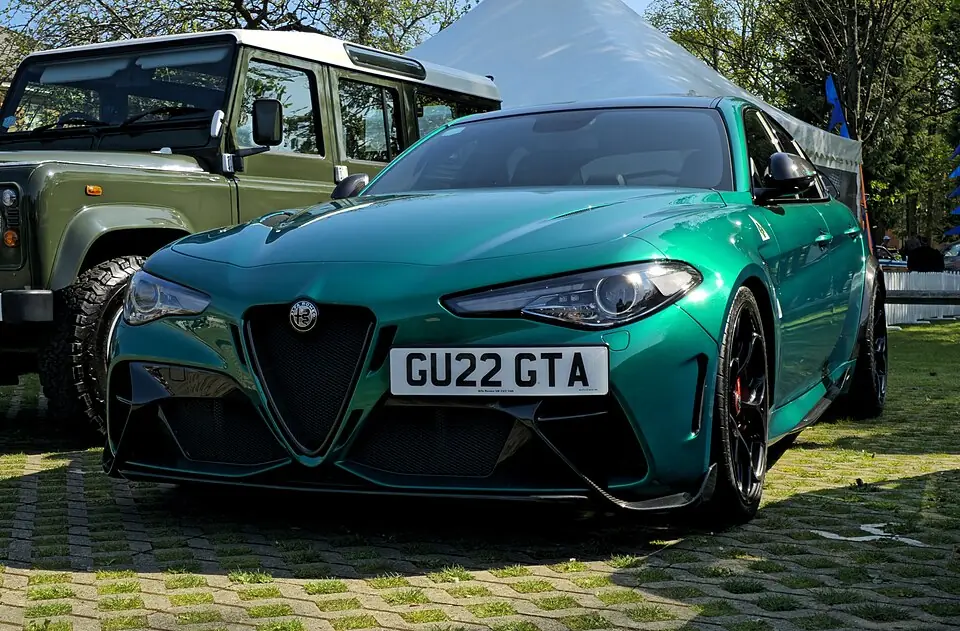
Alfa Romeo Giulia GTA
Why 3.5: Alfa took the Quadrifoglio, cut real weight with carbon body panels and a titanium exhaust, added 30 hp, and built exactly 500 — split between road-biased GTA and track-biased GTAm — never offering either in the US. It wears Forbidden Fruit honestly, and the limited run means most examples are already behaving like collector pieces rather than daily Alfas.
Layout
Natural habitat
Ride comfort
Sound
The 2.9 twin-turbo six revs to 7,300 and the GTA's centre-exit Akrapovic is the loudest exhaust Alfa has fitted this century. But turbochargers now sit where the Busso's induction used to be, and it does not come close to the older Alfa sixes on tone.
6-cylinder · turbocharged · 7,300 rpm redline · rated 7.7 / 10 for engine sound
Market value
Median asking price, good condition · €170k (2020) → €216k (2026), trending up · illustrative data
Child seats · ISOFIX
The road-going, 4-seat GTA (not the 2-seat track-only GTAm) retains the Giulia Quadrifoglio's rear bench and door furniture, carrying over the same rear ISOFIX anchors.
Front positions are fixed Sabelt carbon-shell racing buckets with harness slots, not a child-seat-compatible chair.
It's a 500-unit, 510hp limited edition — nobody's really child-seating one, but the hardware inheritance is there on paper.
Alfa Romeo GTA press/spec material, cross-referenced with Giulia Quadrifoglio data (owner-community sourced, not manufacturer documentation)
The long version
Alfa Romeo built the GTA to mark its 110th anniversary and to remind everyone the badge used to mean something on a race track, taking real weight out of an already-quick Quadrifoglio rather than just adding another power bump. Buyers who paid the roughly 50-percent premium over a standard QV were mostly existing Alfa collectors and Italian-car specialists rather than new-to-the-brand converts, which produced an ownership pattern that skews toward preservation from day one — a 500-unit run doesn't get driven the way an unlimited-production Quadrifoglio does. The GTAm variant, with its roll cage and fixed bucket seats, splits even further toward track use for the minority who bought it to compete rather than to own a numbered plaque. It never crossed the Atlantic, so the entire population lives in Europe, watched by American enthusiasts through import forums the same way earlier forbidden Alfas were.