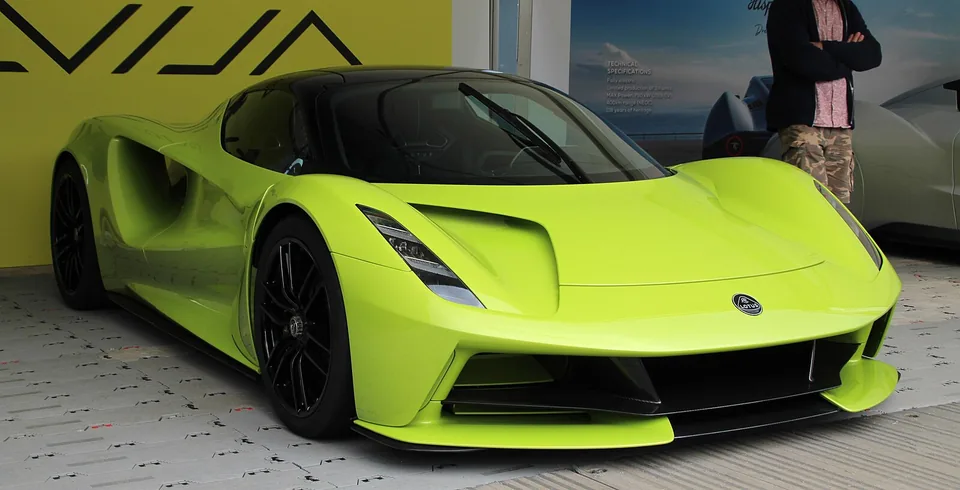
Lotus Evija
Why 2.3: The most powerful car Lotus has ever put into series production, and the first electric one — 130 planned, a motor at each wheel, 2,012 hp, and a mission that is at least as much corporate as automotive. It exists to tell the market what Lotus is now, and it is bought by people who want to be seen agreeing.
Layout
Natural habitat
Ride comfort
Sound
Lotus had a producer digitise a Type 49's Cosworth DFV and slow it down until it matched the drivetrain's own frequencies — the only electric car here whose soundtrack began as a real racing engine. It is still a recording, played through speakers, over a car that makes none of it. Top of the electric pile, a thin summit.
electric · rated 1.2 / 10 for engine sound
Market value
Median asking price, good condition · €2.1M (2023) → €1.9M (2026), trending down · illustrative data
Child seats · ISOFIX
There aren't any — strict two-seater.
The only position there is, so makers of this era equip it: expect a passenger-airbag cut-off (key switch or occupant sensing) as standard, because there is no rear row to point children to. Whether the seat itself carries ISOFIX anchors is maker-specific — Porsche bundles them with its child-seat preparation, Ferrari sold them as an option, others are belt-mount only with the airbag off.
Derived from production years and seating layout, not a per-car source. ISOFIX was standardised as ISO 13216 in 1997, required on new EU model types from 2011 and on all new EU cars from 2014.
The long version
Chapman's company spent seventy years insisting that lightness solved every problem, then launched a 1,887 kg halo car with a 93 kWh battery. The engineering is real: four 375 kW motors, one per wheel, torque vectoring with no mechanical differential anywhere, a Venturi tunnel through each rear haunch that you can see daylight through. So is the ambivalence. The Evija arrived years late — announced in 2019, first customer car handed to Jenson Button in August 2023 — and deliveries have trickled rather than flowed, which means the fleet is both tiny and young. What use pattern exists is the one this Index scores lowest: a two-tonne electric hypercar with a modest usable range is a difficult thing to take anywhere, and the cars are bought largely as statements about where Lotus is heading rather than as machines to wear out. Residuals have drifted down rather than up, unusually for a limited-run hypercar, which at least means nobody is holding one for the flip — they are holding it because there is no queue behind them. Interesting car, thin ownership story.