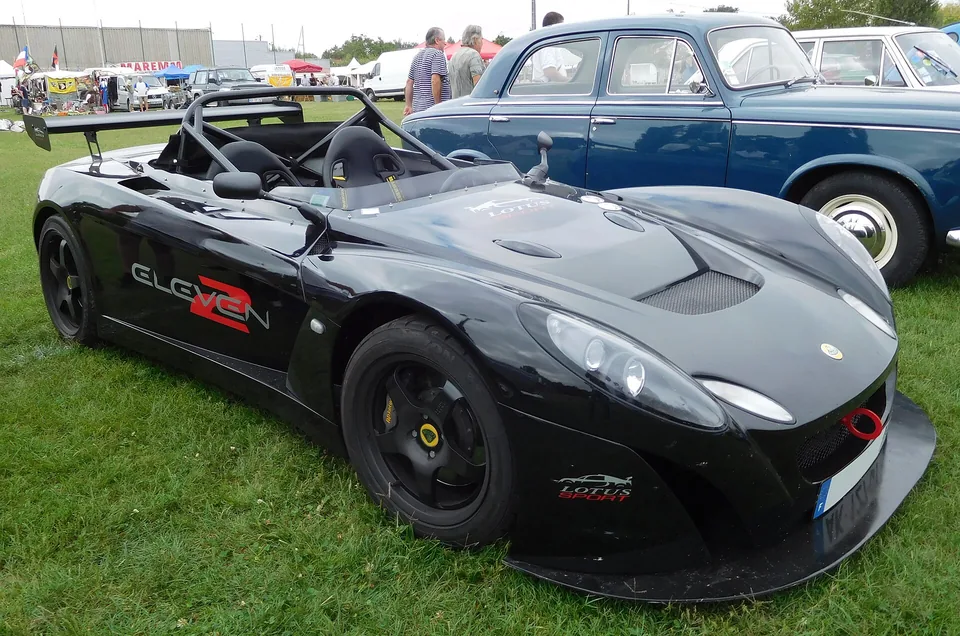
Lotus 2-Eleven
Why 5.8: Lotus Sport took the Exige S2 chassis, removed everything that made it a road car, and sold the result as a track weapon with an optional road package. 670 kg and 252 hp puts it above 375 hp per tonne, and the ownership pattern is exactly what that implies: low road mileage, heavy circuit use, almost no speculation.
Layout
Natural habitat
Ride comfort
Sound
No roof, no screen and no bodywork behind your shoulder, with an Eaton supercharger whining over the 2ZZ's cam change at 6,200 rpm and a side exit about a foot from your ear. But take the theatre away and it is a Toyota 1.8 four, coarse and flat at the top, which lands it below the Exige Cup 430's V6 rather than beside it.
4-cylinder · supercharged · 8,000 rpm redline · rated 7.2 / 10 for engine sound
Market value
Median asking price, good condition · €74k (2007) → €87k (2026), trending up · illustrative data
Child seats · ISOFIX
There aren't any — strict two-seater.
No anchors, and on most of these no passenger airbag either — the car is too stripped for the question to arise. Whatever goes in that seat goes in on a harness or a belt.
Derived from production years and seating layout, not a per-car source. ISOFIX was standardised as ISO 13216 in 1997, required on new EU model types from 2011 and on all new EU cars from 2014.
The long version
The 2-Eleven is the third car in a line Lotus keeps returning to — 340R, 2-Eleven, 3-Eleven — in which an existing Elise-family chassis loses its roof, its doors and usually its windscreen in exchange for a power-to-weight figure. Here the donor is the Exige S2 and the engine is the supercharged and intercooled Toyota 2ZZ-GE, making 252 bhp at 8,000 rpm through the cam-change threshold at around 6,200. Dry weight is 670 kg for the road car and a handful less for the track version, 0–60 takes 3.8 seconds, and the bodywork generates real downforce rather than styling. Around 356 were built across four years. The road-legal question is the interesting part of the ownership story: the car was sold as a track machine at £39,995, and making one road-legal was a £1,100 option covering the lighting and equipment needed to register it, which means the split between road-registered and track-only cars was decided one order form at a time. That has produced an unusually clean pattern. Nobody bought a 2-Eleven as an investment — there was no market to flip into, values sat flat for a decade, and the cars that exist are overwhelmingly in the hands of people who use them at circuits. Road mileage is therefore minimal and the miles-driven factor here is low, but that is a statement about what the car is for rather than about neglect. Almost every one is being driven exactly as intended.