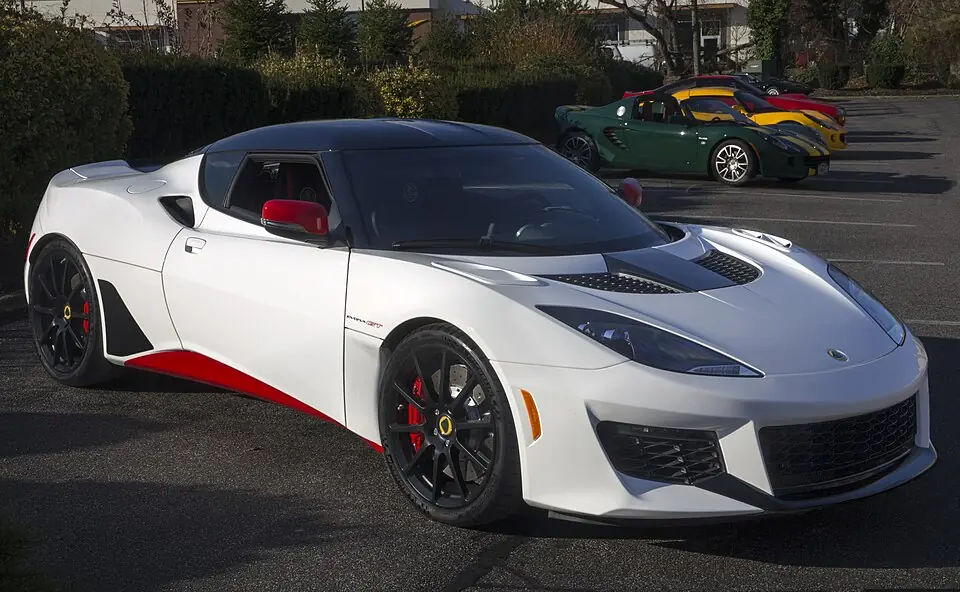
Lotus Evora GT
Why 6.5: Lotus stripped weight and stiffened the final Evora into its best version right before replacing the whole model with the Emira — a mid-engine, manual, sub-1,450kg car that got better as the nameplate ran out of time. Buyers who found it knew exactly what they were getting and drive it accordingly.
Layout
Natural habitat
Ride comfort
Sound
The supercharged 2GR sits inches behind your head with barely any bulkhead, so blower whine and induction reach you directly rather than through a pipe. But it is a Toyota V6 at heart and the whine does most of the work, which is the same borrowed drama as the Jaguars.
6-cylinder · supercharged · 7,000 rpm redline · rated 7.3 / 10 for engine sound
Market value
Median asking price, good condition · €89k (2020) → €74k (2026), trending down · illustrative data
Child seats · ISOFIX
The +2 rear seats carry a genuine ISOFIX latching bracket, though the tight bucket shape realistically limits fitment to compact Group 1/2 seats.
No front ISOFIX, and Lotus's manual actively warns against a front child seat over airbag proximity — switch the airbag off first if you must.
Lotus Evora Owner's Handbook; Lotus genuine parts catalogue (ISOFIX latching bracket A132U0438F)
The long version
The GT was Lotus's send-off for the Evora nameplate, arriving in its final model year with more aggressive aero, bigger brakes, and a diet that made it the lightest Evora Lotus had built since the model launched a decade earlier — everything the Emira would inherit, proven first on the older chassis. Buyers who cross-shopped this against a Cayman or an Emira and picked the outgoing Lotus anyway tend to be the kind who already knew the badge's reputation for being driven hard rather than shown off, and the supercharged Toyota V6 gave them enough reliability margin to actually do it. It never built a speculative bubble the way some 'last of' cars do, because Lotus buyers as a group have always been enthusiasts first — values slid at a normal sports-car pace after launch rather than holding artificially. What's on the road now is disproportionately still being driven the way Hethel intended: back roads, track days, and very little garage time.