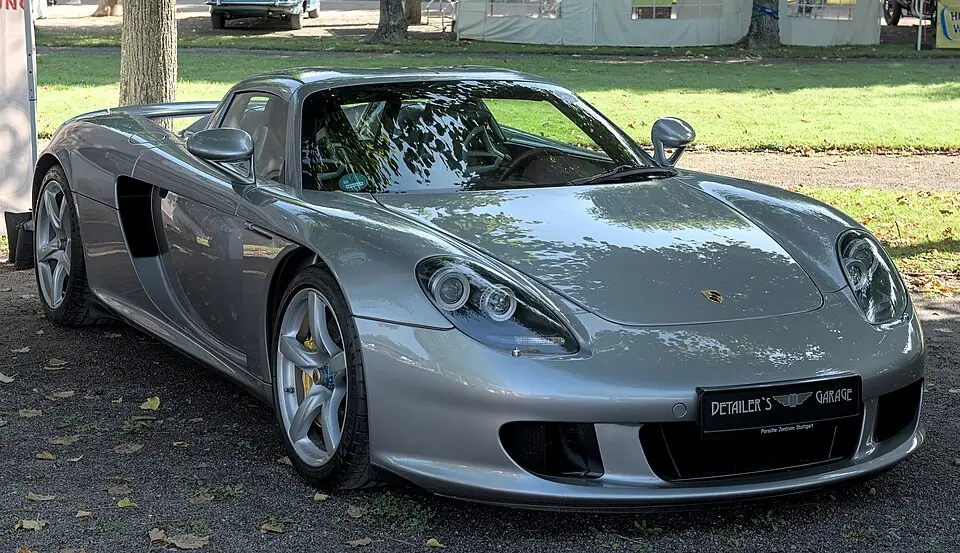
Porsche Carrera GT
Why 3.8: An NA V10, a gated manual and no electronic net — the most analog supercar of its century. Seven-figure values now keep most of them asleep.
Layout
Natural habitat
Ride comfort
Sound
A racing V10 with almost nothing between it and your head — no turbos to muffle it, barely any sound deadening, and 8,400 rpm to work with. It loses a fraction to the LFA only because Porsche tuned it for speed and the noise is a by-product rather than the point.
10-cylinder · naturally aspirated · 8,400 rpm redline · rated 9.8 / 10 for engine sound
Market value
Median asking price, good condition · €386k (2006) → €1.6M (2026), trending up · illustrative data
Child seats · ISOFIX
There aren't any — strict two-seater.
No child-seat option turns up in Porsche's records or the aftermarket. The seats are fixed carbon-composite buckets built into the monocoque — you adjust the pedals, not the seat — which makes ISOFIX a non-starter architecturally.
US sales ended early in 2006 because its single-stage airbags couldn't meet the incoming federal advanced-airbag rule, and Porsche didn't think re-certification was worth it this late in the run.
Autoweek, Aug 2005 (Porsche Carrera GT US production halt); Carrera GT fixed-seat/adjustable-pedal-box design (owner-community sourced, not manufacturer documentation)
The long version
At current money a Carrera GT buyer is choosing a museum piece with a title, and most treat it that way: the ceramic clutch and total absence of stability control make a fender-bender a six-figure lesson, so insurance-company logic wins over impulse. A determined minority still drive it the way Porsche intended, which is presumably why it has not been demoted to pure art object. Garage Queen fits the collection; F1 DNA nods to the discarded Le Mans program that donated the engine. Values have roughly quadrupled since the mid-2000s trough, and that kind of chart is what keeps keys in a drawer.