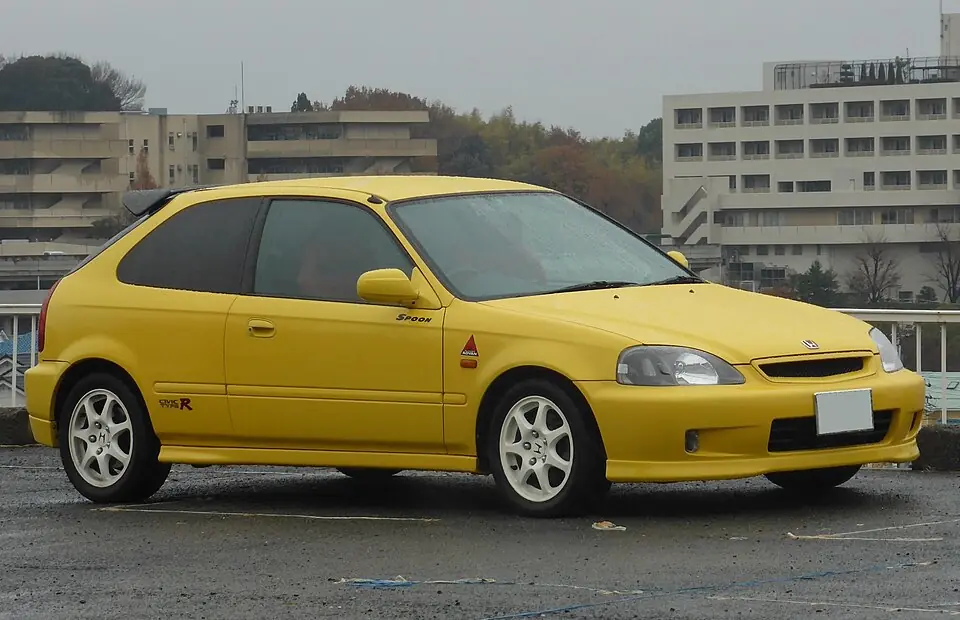
Honda Civic Type R (EK9)
Why 5.3: A hand-ported 1.6 spinning to 8,400 rpm in a 1,070 kg shell, JDM-only. Import prices doubled; the faithful still run touge and track days.
Layout
Natural habitat
Ride comfort
Sound
The B16B changes voice entirely at the VTEC crossover and screams to 8,400 rpm out of 1.6 litres — the trick the S2000 later did with more capacity. But 185 hp and a small bore leave it weightless below 6,000. Short of the S54 and F20C, clear of every turbo hatch.
4-cylinder · naturally aspirated · 8,400 rpm redline · rated 7.9 / 10 for engine sound
Market value
Median asking price, good condition · €9k (2005) → €46k (2026), trending up · illustrative data
Child seats · ISOFIX
ISOFIX was spreading through these years rather than fitted across the board — whether a given car has rear anchors depends on its year and market.
Children were expected in the back. Front-passenger ISOFIX effectively didn't exist in this era, and airbag deactivation was patchy — treat the front seat as a no unless a specific car proves otherwise.
Derived from production years and seating layout, not a per-car source. ISOFIX was standardised as ISO 13216 in 1997, required on new EU model types from 2011 and on all new EU cars from 2014.
The long version
JDM-only from new, so every US example is a 25-year-rule import, and the wave of American buyers discovering the B16B over the last several years is a meaningful chunk of why values have climbed sharply — collector demand arriving from a market that was never supposed to have access. In Japan, where the car never needed importing, the touge and track-day culture around it is still alive, run by owners who treat a hand-ported 1.6 revving to 8,400 rpm as something to use up, not preserve. The export price spike is pulling more of the surviving population toward preservation than the domestic culture ever did on its own.