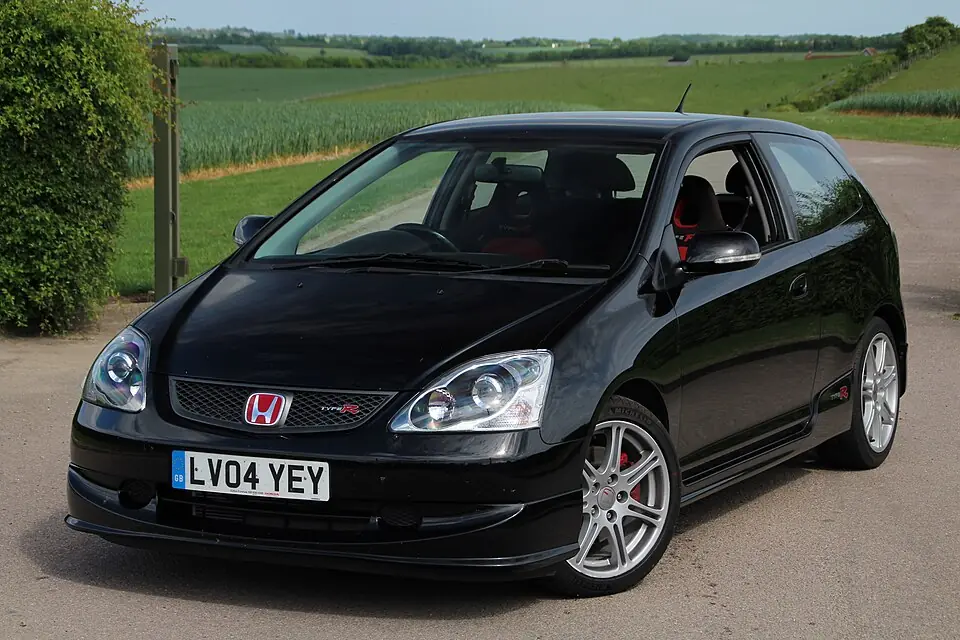
Honda Civic Type R (EP3)
Why 6.0: A 2.0-liter K20 revving to 8,000 rpm and a helical limited-slip diff in a chassis road testers criticized for looser steering feel than the EK9 or DC2 it followed — the unloved middle sibling of the Type R lineage, now catching up on value as the whole nameplate's history gets reappraised.
Layout
Natural habitat
Ride comfort
Sound
The K20 changes voice at about 5,800 rpm when VTEC engages and pulls hard to 8,000, which is the entire reason the car exists. But the EP3 keeps a muted standard silencer and intake, so it delivers S2000 drama at a fraction of the volume.
4-cylinder · naturally aspirated · 8,000 rpm redline · rated 6.9 / 10 for engine sound
Market value
Median asking price, good condition · €21k (2001) → €20k (2026), trending down · illustrative data
Child seats · ISOFIX
PistonHeads' Civic Type R buying guide describes ISOFIX child-seat mounts in the EP3's rear, and UK/Australian owner forums (Civinfo, Ozhonda) separately confirm the rear anchor points.
No front-seat ISOFIX — same pattern as every other Civic Type R generation.
PistonHeads Honda Civic Type R buying guide (EP3 interior section) + Civinfo/Ozhonda owner-forum ISOFIX threads (owner-community sourced, not manufacturer documentation)
The long version
Honda sold this generation everywhere except the country that would eventually buy the most Civic Type Rs, leaving American enthusiasts to watch UK and Japanese market cars from outside a 25-year import window for two full decades. Reviewers at launch noted the steering felt less connected than the EK9 that preceded it, which kept prices soft relative to more celebrated Hondas for most of its life. That gap is finally closing as the whole Type R nameplate's back catalog gets reappraised and the import window opens, with clean, unmodified examples pulling away from the tracked, torn-up cars that made up most of the used population for years.