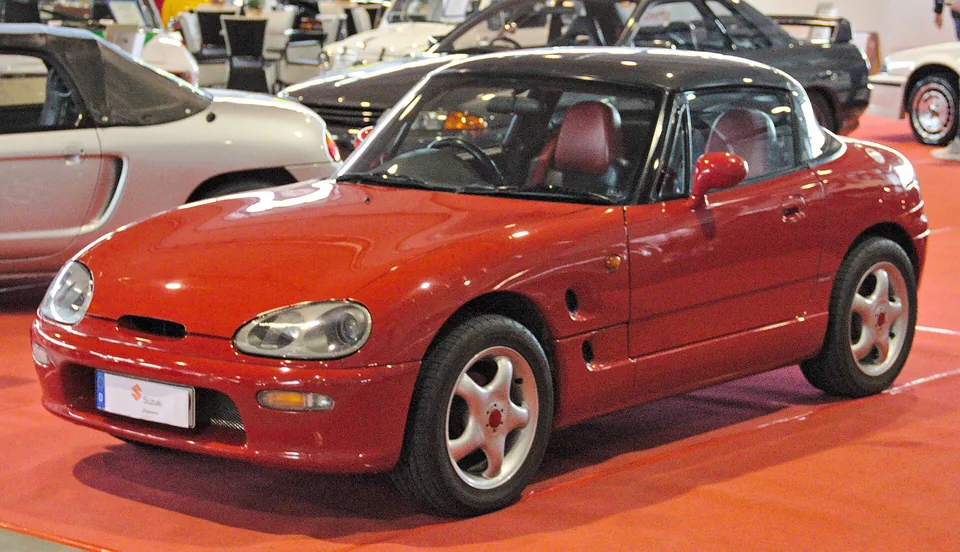
Suzuki Cappuccino
Why 7.2: Japan's kei rules fixed the size at 3.3 metres, the engine at 660 cc and, by an agreement between the manufacturers, the output at 64 PS — so Suzuki spent everything the rules left it on layout. The turbo triple sits behind the front axle driving the rear wheels, the claimed balance is 50/50 with both seats occupied, and the aluminium roof comes off in three panels that stow in the boot.
Layout
Natural habitat
Ride comfort
Sound
The F6A is a twelve-valve turbo triple with the tachometer marked at 8,500 and almost no bodyshell around it to absorb anything. But it sits ahead of the bulkhead rather than behind your head, so the AZ-1's shove-it-in-your-ear intimacy is missing and the turbo blurs what is left. Distant, by kei-car standards.
3-cylinder · turbocharged · 8,500 rpm redline · rated 5.5 / 10 for engine sound
Market value
Median asking price, good condition · €12k (1992) → €15k (2026), trending up · illustrative data
Child seats · ISOFIX
There aren't any — strict two-seater.
The only position there is — and the weak point of this era. Airbag cut-off switches only became routine in the mid-2000s; many of these cars have none from the factory, which rules out a rear-facing seat entirely unless a dealer-fitted deactivation was installed. Forward-facing on the belt, seat slid fully back, is what the period manuals allow.
Derived from production years and seating layout, not a per-car source. ISOFIX was standardised as ISO 13216 in 1997, required on new EU model types from 2011 and on all new EU cars from 2014.
The long version
The Cappuccino is what happens when an engineering team is handed a box it cannot make bigger and decides to fill it perfectly instead. Three roof panels turn the same car into a coupé, a T-top, a targa or a full roadster depending on how much of the afternoon you want to spend on it, and underneath is a proper front-mid rear-drive chassis rather than the sideways-engine front-drive layout every other kei car of the period used. It sold hardest at the start: 15,113 cars in the first two years, 88 per cent of them in Japan. Britain is the interesting footnote — Suzuki launched it here in October 1993 at £11,995 and registered 1,110 cars in two years, which makes this one of the very few kei cars ever sold new through a European dealer network rather than smuggled in later by an importer. America never got that chance and has been collecting them one model year at a time since the twenty-five-year rule caught up in 2016. Values did what that pattern always does: near-nothing through the 2000s, a slow climb as the import window opened, and a market now made up almost entirely of people who wanted this specific car. Nobody has ever bought a 64 PS kei roadster as an investment, and the mileage on the ones that come up for sale says so.