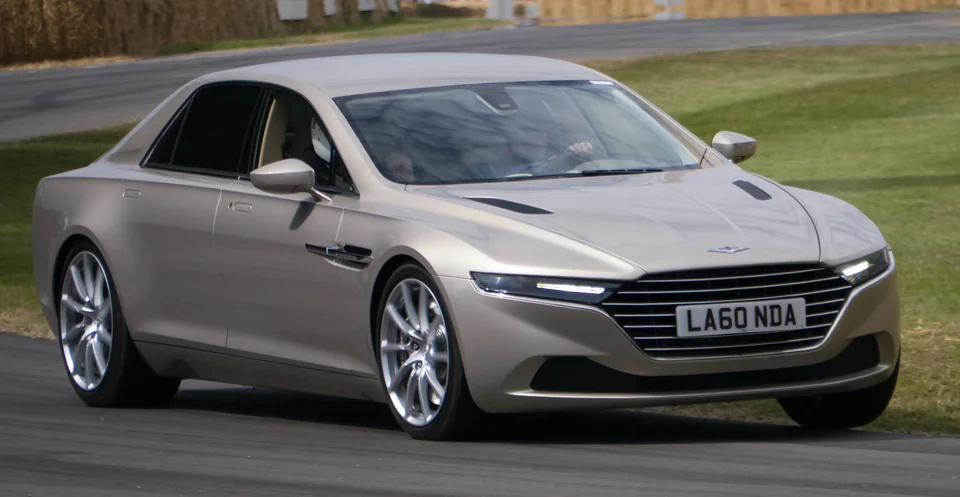
Aston Martin Lagonda Taraf
Why 2.0: A hand-built carbon-bodied four-door on a stretched version of Aston's VH platform, with the naturally aspirated 5.9-litre V12 and a rear-wheel-drive chassis, sold initially only in the Middle East at roughly a million dollars. Aston revived the Lagonda name for it and then let it disappear again.
Layout
Natural habitat
Ride comfort
Sound
Aston's 6.0 V12 keeps a hard edge at the top that most luxury twelves never find, and there is no turbo softening it. But the Taraf is a limousine engineered around rear-seat quiet, so the best of the engine is deliberately held away from the people paying for it.
12-cylinder · naturally aspirated · 6,750 rpm redline · rated 6.7 / 10 for engine sound
Market value
Median asking price, good condition · €920k (2015) → €644k (2026), trending down · illustrative data
Child seats · ISOFIX
Two ISOFIX positions on the outer rear seats, the outer pair being the ones the standard covers.
The rear anchors are the supported route — the manual points child seats there, and front-passenger ISOFIX is the exception rather than the rule. A belt-mounted seat up front needs the airbag off, and cars with a rear row don't always fit a deactivation switch, precisely because the rear seats exist.
Derived from production years and seating layout, not a per-car source. ISOFIX was standardised as ISO 13216 in 1997, required on new EU model types from 2011 and on all new EU cars from 2014.
The long version
The Taraf is the strangest thing Aston Martin built in the 2010s and the company has said very little about it since. It began as a Middle East exclusive in 2014, priced at around $1 million against a Rolls-Royce Ghost at less than half that, and was later offered in Europe, the UK and South Africa without ever being certified for North America. Aston talked about 200 cars and built 120. The engineering is real — carbon-fibre body panels over a bonded aluminium structure stretched from the Rapide, hand-finished at Gaydon — but the proposition never made sense to anyone outside the specific market it was aimed at, where the badge scarcity was the product. What happens to a car like that is entirely predictable and this index has seen it before: they are bought as objects, they are stored, and the mileage figures on the handful that surface at auction are measured in the hundreds rather than the thousands. Values fell hard against the original price and have only partly recovered, because a car nobody drives and nobody recognises has very little to sustain it. It is the purest kind of entry on this list — a genuinely interesting piece of engineering, built for a reason that had nothing to do with driving it.