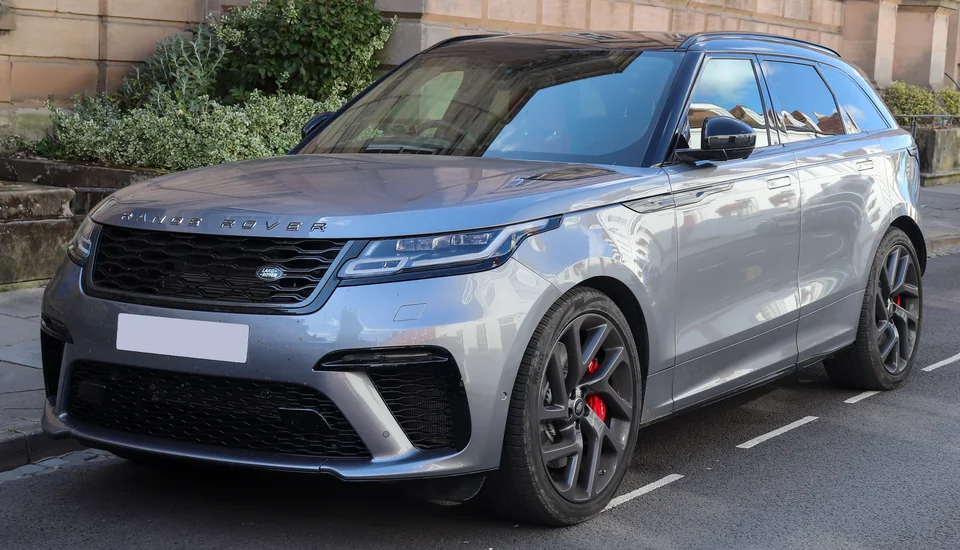
Range Rover Velar SVAutobiography
Why 4.0: Land Rover's Special Vehicle Operations put the 550 hp supercharged V8 from the F-Type SVR into the Velar, added a quad exhaust, uprated brakes and a firmer air-spring calibration, and built it for a single model year. It is fast in a straight line and entirely uninterested in what happens after that.
Layout
Natural habitat
Ride comfort
Sound
The supercharged 5.0 brings the same whine and overrun crackle as the F-Type, and the variable-valve exhaust does open properly in Dynamic. But it is hauling two tonnes of Range Rover behind acoustic glass, so everything reaches you one layer removed.
8-cylinder · supercharged · 6,500 rpm redline · rated 6.8 / 10 for engine sound
Market value
Median asking price, good condition · €84k (2020) → €44k (2026), trending down · illustrative data
Child seats · ISOFIX
Two ISOFIX positions on the outer rear seats, the outer pair being the ones the standard covers.
The rear anchors are the supported route — the manual points child seats there, and front-passenger ISOFIX is the exception rather than the rule. A belt-mounted seat up front needs the airbag off, and cars with a rear row don't always fit a deactivation switch, precisely because the rear seats exist.
Derived from production years and seating layout, not a per-car source. ISOFIX was standardised as ISO 13216 in 1997, required on new EU model types from 2011 and on all new EU cars from 2014.
The long version
The Velar was the design-led Range Rover — the one that won awards for its flush door handles and its two-screen interior and sold to people who chose it in a showroom on the strength of how it looked. The SVAutobiography Dynamic Edition took that car, which was never conceived as a performance product, and gave it the supercharged V8 anyway. Land Rover built it for one year only and in small numbers, and the result is the most concentrated example on this shelf of the pattern this index exists to measure. It cost over $90,000 in the United States, more than a Cayenne S; it is heavier and less capable than any of its rivals through a corner; and the specification exists to be read on the tailgate rather than used. Owners cover very little distance in them, because the Velar's whole proposition is short journeys made in an object people look at, and because 5.0 supercharged litres in a 2.1-tonne SUV returns fuel consumption that discourages the long ones. Depreciation has been severe and unsentimental — a limited production run means nothing when the car underneath it is a mid-size crossover. The single model year gives it scarcity. Scarcity has not given it a market.