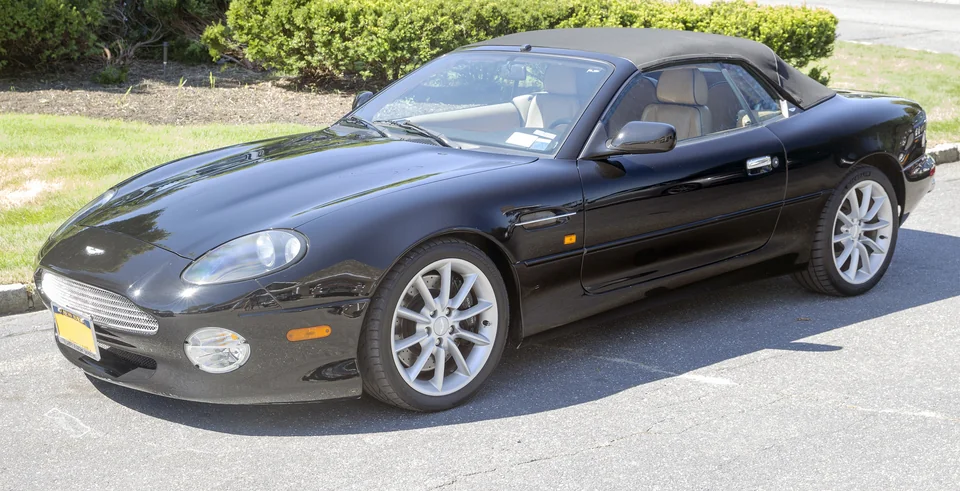
Aston Martin DB7 Vantage Volante
Why 5.5: The DB7 Vantage is where Aston Martin's V12 begins — 5.9 litres, 420 hp, built from a pair of Ford Duratec V6 blocks under Cosworth's supervision — and the Volante is the version that admits what the car is. Underneath is a heavily reworked Jaguar XJS floorpan, which is either the best or the worst fact about it depending on your priorities.
Layout
Natural habitat
Ride comfort
Sound
The 5.9 V12 is deep and smooth, and with the roof folded you hear it directly rather than through Aston's sound deadening. But it is two Ford V6s joined at the crank, tuned for refinement, and 6,500 rpm gives it nowhere dramatic to go at the top.
12-cylinder · naturally aspirated · 6,500 rpm redline · rated 7.6 / 10 for engine sound
Market value
Median asking price, good condition · €152k (2002) → €51k (2026), trending down · illustrative data
Child seats · ISOFIX
ISOFIX was spreading through these years rather than fitted across the board — whether a given car has rear anchors depends on its year and market.
Children were expected in the back. Front-passenger ISOFIX effectively didn't exist in this era, and airbag deactivation was patchy — treat the front seat as a no unless a specific car proves otherwise.
Derived from production years and seating layout, not a per-car source. ISOFIX was standardised as ISO 13216 in 1997, required on new EU model types from 2011 and on all new EU cars from 2014.
The long version
The DB7 is the car that saved Aston Martin, and it did so by being a Jaguar underneath at a moment when Ford owned both and needed a product that could be built in volume. Roughly 7,000 DB7s left Bloxham, more than every previous Aston combined, and the Vantage with the V12 was the version that arrived in 1999 to replace the supercharged straight-six. On the road it was never a sports car. It is a soft, long-geared, beautifully proportioned grand tourer that sounds enormous and rides like it was tuned for the M4, and in Volante form with the Touchtronic automatic it is essentially a boulevard car with a V12. The market has priced it accordingly for two decades: a $165,000 car in 2002 bottomed out around $40,000, less than the cost of the engine's rebuild, and stayed there. That is why the flip factor is high and the mileage is not. Owners are people who wanted a twelve-cylinder Aston at a price they could justify, and they use it for what it is good at — sunny weekends, long routes, no hurry — while the running costs quietly discourage anything more ambitious. Values have crept up as the model has aged into a proper classic. Nobody has ever made money on one.