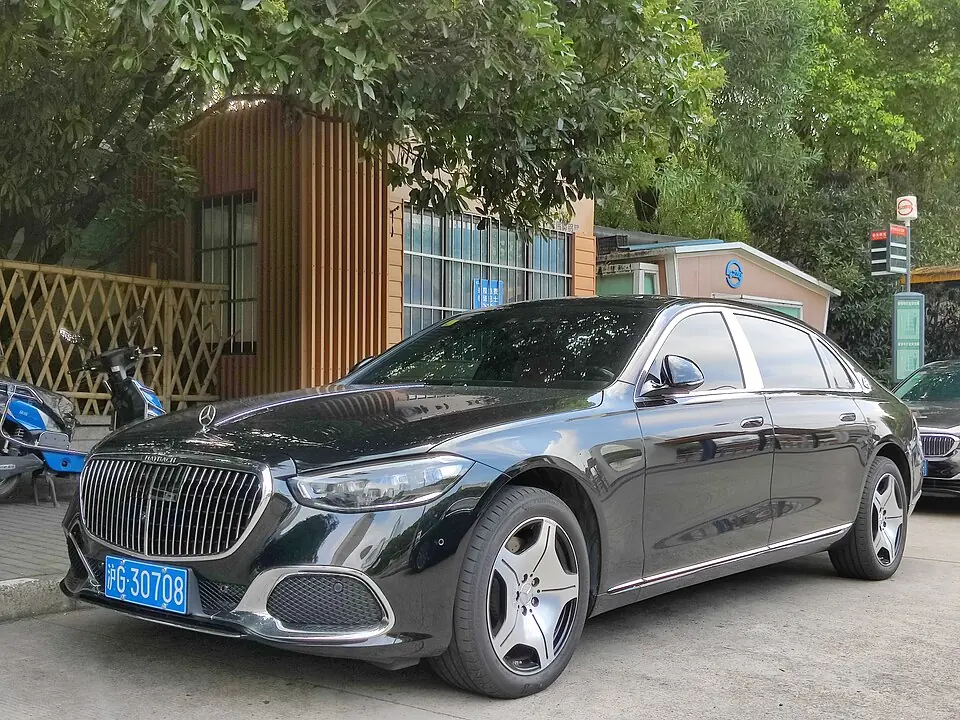
Mercedes-Maybach S-Class
Why 4.3: Doug clocked a 7 for Acceleration on the hybrid inline-six, unusually athletic for a chauffeur car — but Comfort and Quality both hit 9, and that's the actual sales pitch. Nobody cross-shops this against anything with a manual gearbox.
Layout
Natural habitat
Ride comfort
Sound
The turbocharged six is inherently smooth and there is a faint hum under load if you go looking for it. But Maybach spends real money on acoustic glazing and noise cancellation to remove it — the engine is treated as a fault to be engineered out.
6-cylinder · turbocharged · 6,500 rpm redline · rated 3.0 / 10 for engine sound
Market value
Median asking price, good condition · €166k (2021) → €106k (2026), trending down · illustrative data
Child seats · ISOFIX
Rear ISOFIX carries over from the standard S-Class, which has had it since Mercedes pioneered the system on the W220 in 1998 — present even alongside the Maybach's reclining 'executive' rear seats.
No ISOFIX on the front passenger seat.
The W223-generation S-Class adds interior cameras that flag an installed child seat if the belt isn't buckled — a newer layer on top of the physical anchors.
Mercedes-Benz S-Class (W223) product documentation (child-seat-aware camera monitoring) + S-Class ISOFIX lineage dating to the W220 (owner-community sourced, not manufacturer documentation)
The long version
Mercedes builds the Maybach on the same line as the standard S-Class, then spends the difference entirely on the rear compartment — reclining seats, four-zone climate, glass separating the driver from a cabin tuned like a private jet. Depreciation here is famously brutal, steeper than the S-Class it's based on, because buyers churn through the newest model year rather than holding one the way a Rolls-Royce owner might. That trade-off is the point: a luxury good bought to be current, not a collectible bought to be kept, and the ownership data reads exactly like that.