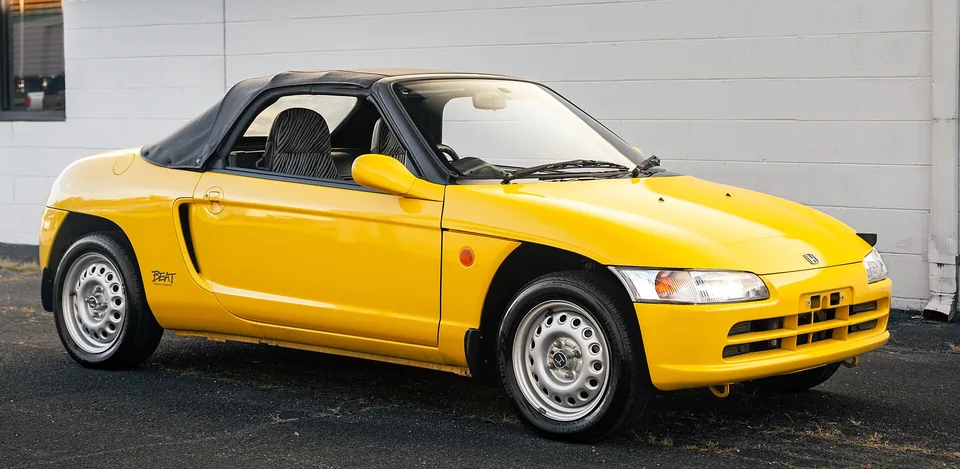
Honda Beat
Why 7.3: A transverse mid-engined roadster built to kei dimensions, with no turbocharger, no automatic option and no power steering. MTREC gives each of the three cylinders its own throttle body, which is why 656 cc makes its 64 PS all the way up at 8,100 rpm instead of somewhere sensible.
Layout
Natural habitat
Ride comfort
Sound
MTREC gives each of the three cylinders its own throttle body, so the induction sharpens behind your shoulders all the way to 8,100 rpm with no turbocharger in the path to blur it. But it is still 656 cc making 63 hp, thin where a real engine would have body. The most tuneful noise a kei car makes, and still a small one.
3-cylinder · naturally aspirated · 8,100 rpm redline · rated 6.4 / 10 for engine sound
Market value
Median asking price, good condition · €11k (1992) → €16k (2026), trending up · illustrative data
Child seats · ISOFIX
Built before ISOFIX existed, so there are no anchor points at all. A child seat here is a seatbelt installation in the only passenger seat there is.
Derived from production years and seating layout, not a per-car source. ISOFIX was standardised as ISO 13216 in 1997, required on new EU model types from 2011 and on all new EU cars from 2014.
The long version
Honda launched the Beat in May 1991 and sold it only in Japan, through the Primo dealer channel, and it is routinely described as the last car Soichiro Honda approved before his death that August. Roughly 33,600 were built and about two-thirds of them went in the first year, which tells you the shape of the thing: an impulse purchase at the very top of the bubble, and then a long tail of indifference once the economy turned. Everything about the specification is stubborn in a way no accountant would sign off today. It is mid-engined and rear-driven when a front-drive layout would have been cheaper and roomier. It has a fabric roof and no hardtop option, so it is a convertible or nothing. It came with a five-speed manual and never anything else. And instead of the turbocharger every rival used to reach the 64 PS ceiling, Honda used individual throttle bodies and revs, which is a far more expensive way to arrive at exactly the same number. What that buys is the one thing a turbo kei car cannot give you: a throttle that answers instantly and an engine that keeps going when you expect it to stop. Values sat at scrap money for two decades and have climbed steadily since the import window opened, but they are still cars people drive rather than store.