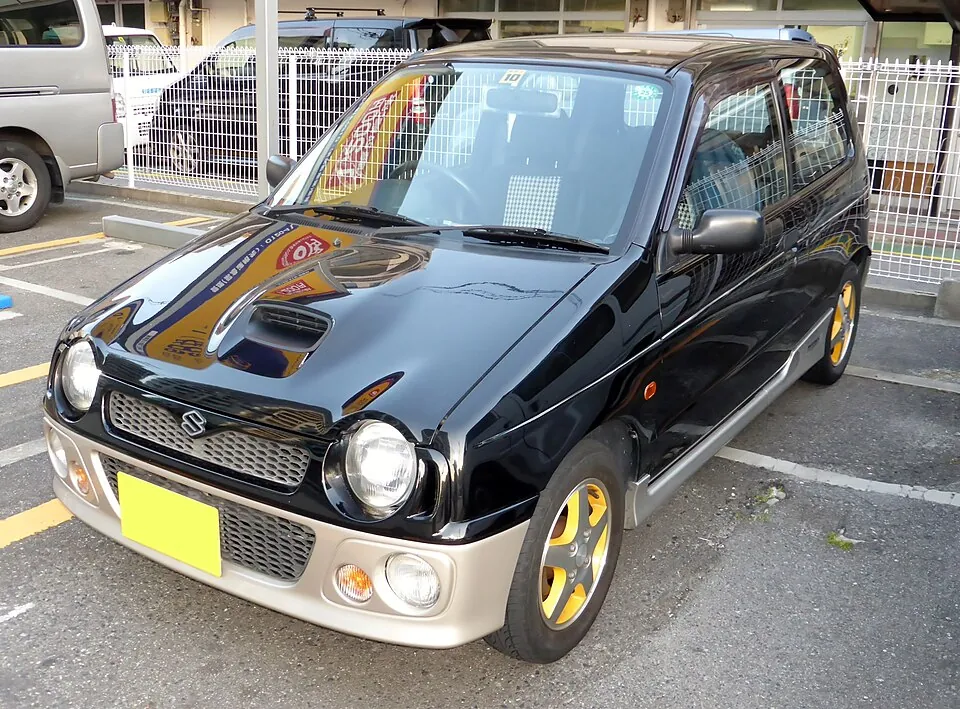
Suzuki Alto Works
Why 7.1: Japan's kei rules cap the engine at 660 cc and, by an agreement between the manufacturers, the output at 64 PS. Suzuki's response was to turbocharge, twin-cam and intercool a three-cylinder to hit that ceiling in a car weighing about 700 kg, then offer it with four-wheel drive. The result is comically fast for what it is.
Layout
Natural habitat
Ride comfort
Sound
A 660 cc triple spinning past 8,000 with a turbo whistle out of all proportion to it is properly distinctive, and the thin bodyshell hides none of it. But three cylinders and two-thirds of a litre give it no depth, so it charms rather than impresses.
3-cylinder · turbocharged · 8,000 rpm redline · rated 6.0 / 10 for engine sound
Market value
Median asking price, good condition · €9k (1995) → €14k (2026), trending up · illustrative data
Child seats · ISOFIX
ISOFIX was spreading through these years rather than fitted across the board — whether a given car has rear anchors depends on its year and market.
Children were expected in the back. Front-passenger ISOFIX effectively didn't exist in this era, and airbag deactivation was patchy — treat the front seat as a no unless a specific car proves otherwise.
Derived from production years and seating layout, not a per-car source. ISOFIX was standardised as ISO 13216 in 1997, required on new EU model types from 2011 and on all new EU cars from 2014.
The long version
Every Alto Works is an argument with a rulebook. The kei class limits length, width and displacement, and from 1990 the Japanese manufacturers agreed among themselves not to quote more than 64 PS — so the entire engineering effort went into everything that number does not describe. Suzuki fitted a DOHC turbocharged three-cylinder with an intercooler, kept the weight near 700 kg, offered four-wheel drive and a five-speed manual, and produced a car whose power-to-weight ratio sits alongside cars three times its size. It revs past 8,000, the turbocharger is enormous relative to the engine, and the whole thing is small enough that ordinary roads feel like a rally stage. None of it was ever sold outside Japan through official channels; the Alto has no American history whatsoever, and what exists abroad arrived through the used-import trade. For twenty years these were disposable domestic transport in Japan and priced accordingly, which is exactly why so few good ones survived — and why the ones that did are now the object of a small, obsessive and fast-growing export market.