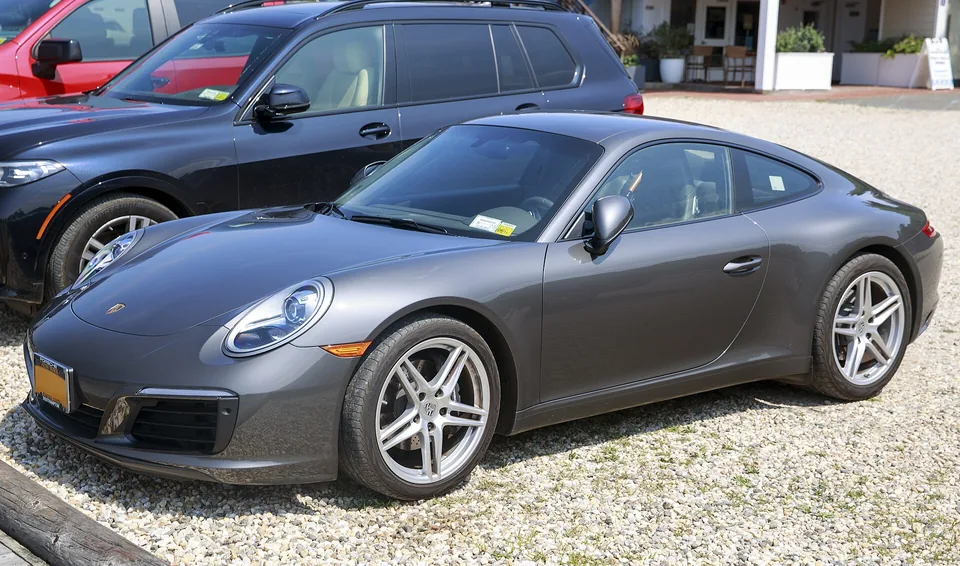
Porsche 911 Carrera (991.2)
Why 8.3: The 2016 facelift swapped the 3.4 for a 3.0-litre twin-turbo flat-six that makes 370 hp and, more to the point, 331 lb-ft from 1,700 rpm. PASM became standard, the touchscreen arrived, and the base Carrera became quicker in a straight line than the 991.1 S it was priced below.
Layout
Natural habitat
Ride comfort
Sound
The 3.0 twin-turbo keeps a trace of flat-six beat at idle and there is audible turbo breathing on lift. But the top end the 991.1 had is gone: boost does the work by 2,000 rpm, the exhaust is muted to suit, and the 7,500 rpm limit is a number rather than an event. The generation change you can hear.
6-cylinder · turbocharged · 7,500 rpm redline · rated 6.3 / 10 for engine sound
Market value
Median asking price, good condition · €82k (2017) → €55k (2026), trending down · illustrative data
Child seats · ISOFIX
Two ISOFIX positions on the outer rear seats — jump seats, so the question is whether the seat physically fits behind a front occupant, not whether the anchors are there.
The rear anchors are the supported route — the manual points child seats there, and front-passenger ISOFIX is the exception rather than the rule. A belt-mounted seat up front needs the airbag off, and cars with a rear row don't always fit a deactivation switch, precisely because the rear seats exist.
Derived from production years and seating layout, not a per-car source. ISOFIX was standardised as ISO 13216 in 1997, required on new EU model types from 2011 and on all new EU cars from 2014.
The long version
Enthusiasts hated the idea of a turbocharged Carrera and bought it anyway, because the 991.2 is a better car to live with than the one it replaced. The torque makes it easier in traffic and on a mountain road, the standard PASM made the ride the best of any 991, and the fuel economy improved enough that the people who already used a 911 as a daily used it more. What the facelift cost was the top end — the 3.0 is done by 7,500 rpm and sounds like it — and that is exactly why this car is not collected. There is no last-of-anything story here, the turbo era continued straight into the 992, and the base Carrera is the version with the smallest wheels and the plainest specification. So it depreciated like a normal car, it is driven like one, and a 991.2 Carrera with 60,000 miles is the honest end of 911 ownership in a way the GT cars will never be.