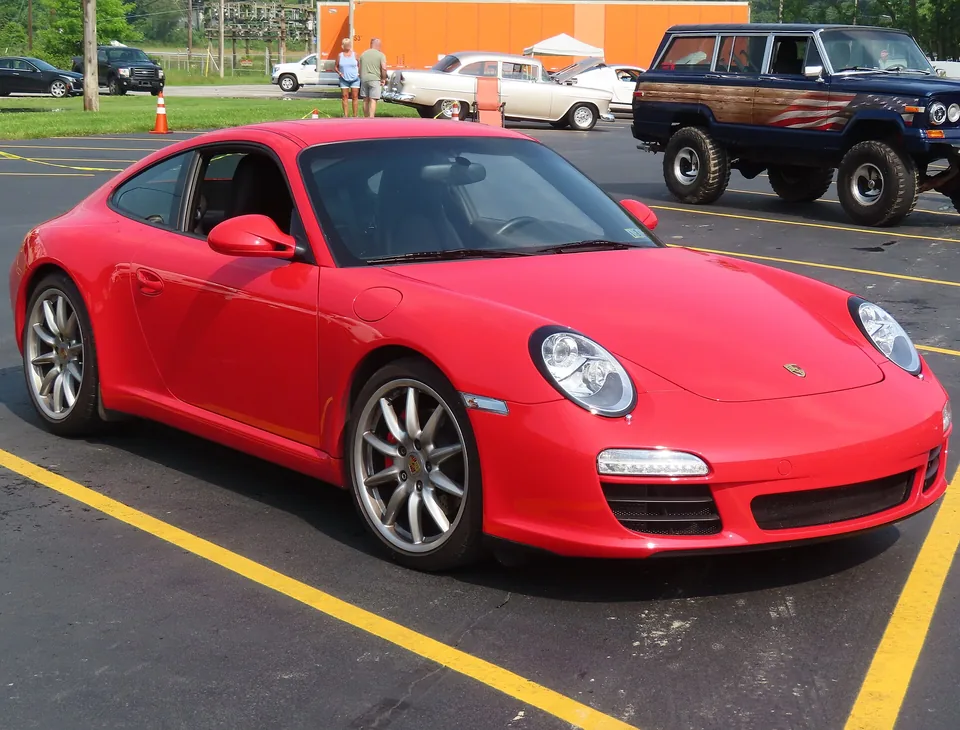
Porsche 911 Carrera S (997)
Why 7.9: A hydraulically assisted rack, a 3.8-litre flat-six that revs to 7,500 rpm in direct-injection 997.2 form, PASM adaptive dampers as standard on the S and the round headlights the 996 had lost. The 997 put the 996's styling mistakes behind it without giving up the way it felt.
Layout
Natural habitat
Ride comfort
Sound
The 997's 3.8 is the best-sounding of the ordinary water-cooled Carreras — the 997.2's direct-injection unit revs to 7,500 and the optional PSE adds a genuine bark. But it is a wet-sump road engine behind a quiet factory exhaust, and the Mezger GT3 of the same era is a league above it. Honest, not thrilling.
6-cylinder · naturally aspirated · 7,500 rpm redline · rated 6.9 / 10 for engine sound
Market value
Median asking price, good condition · €73k (2005) → €55k (2026), trending down · illustrative data
Child seats · ISOFIX
ISOFIX was spreading through these years rather than fitted across the board — whether a given car has rear anchors depends on its year and market.
Children were expected in the back. Front-passenger ISOFIX effectively didn't exist in this era, and airbag deactivation was patchy — treat the front seat as a no unless a specific car proves otherwise.
Derived from production years and seating layout, not a per-car source. ISOFIX was standardised as ISO 13216 in 1997, required on new EU model types from 2011 and on all new EU cars from 2014.
The long version
Porsche built around 213,000 997s, and the Carrera S is the version most of them were. It was the daily 911 of its decade — fast enough to matter, civilised enough to commute in, and cheap enough on the used market by 2015 that a generation of first-time Porsche buyers came in through this door. That population still drives: 997s are the most common 911 at any club meeting, with the mileages to prove it, and the specialist trade exists because the cars are used rather than stored. The 997.2 of 2009 fixed the two things that scared buyers — the M97's intermediate shaft bearing was engineered out of the new direct-injection 9A1, and the slow Tiptronic gave way to PDK — so the later cars are the ones that get worked hardest. Values bottomed around 2016 and have climbed gently since, as the combination of hydraulic steering and a naturally aspirated engine became something Porsche no longer sells below GT3 money. Nobody is speculating yet; they are still driving.