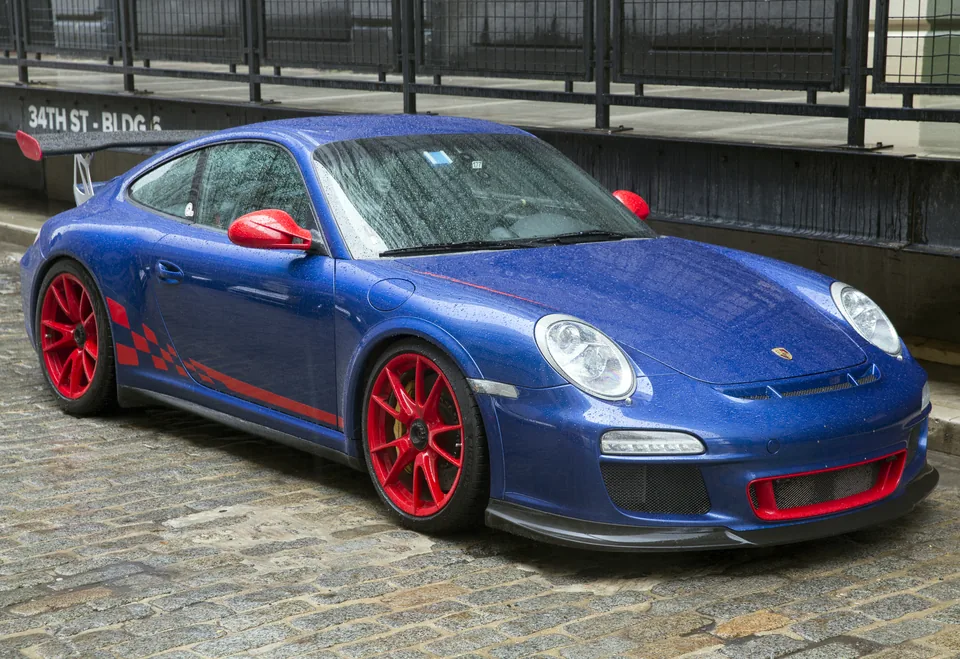
Porsche 911 GT3 RS (997)
Why 4.8: The 997 GT3 RS took the GT3's Mezger engine and hydraulic steering, added the Carrera 4's wider rear body, a carbon wing, a plastic rear window and 20 kg less weight, and for 2010 grew to a 3.8-litre with 450 hp, centre-lock wheels and a titanium exhaust. It was the first GT3 RS sold in the United States and the last one with a manual gearbox as the only choice.
Layout
Natural habitat
Ride comfort
Sound
The GT3's Mezger with the RS's lighter exhaust — titanium on the 3.8 — a plastic rear window and less deadening, so the hard metallic climb to 8,500 rpm fills the cabin. It gives up a tenth to the 4.0 RS, whose single-mass flywheel and extra 200 cc add volume up top. Level with the 992 GT3, which revs higher in a quieter cabin.
6-cylinder · naturally aspirated · 8,500 rpm redline · rated 9.0 / 10 for engine sound
Market value
Median asking price, good condition · €113k (2007) → €230k (2026), trending up · illustrative data
Child seats · ISOFIX
There aren't any — strict two-seater.
The only position there is, so makers of this era equip it: expect a passenger-airbag cut-off (key switch or occupant sensing) as standard, because there is no rear row to point children to. Whether the seat itself carries ISOFIX anchors is maker-specific — Porsche bundles them with its child-seat preparation, Ferrari sold them as an option, others are belt-mount only with the airbag off.
Derived from production years and seating layout, not a per-car source. ISOFIX was standardised as ISO 13216 in 1997, required on new EU model types from 2011 and on all new EU cars from 2014.
The long version
Two RS populations share one badge. The 997.1 cars from 2006–09 were $125,000 track specials bought by people who used them, and a decade of Porsche Club weekends shows in the odometers; even now a 3.6 RS with 40,000 miles is normal and the values, around $200,000, have not climbed far enough to change that. The 997.2 RS 3.8 is the other population: built for two years, immediately treated as the last pure Mezger RS, and bought at $135,000 by owners who watched the 4.0 above it reach half a million and decided their car was next. Those sit on delivery mileage in climate-controlled garages, trade through specialist dealers rather than between enthusiasts, and surface with the stickers still on the roll cage. The score is the average of a car that is tracked and a car that is stored, which is accurate rather than satisfying.