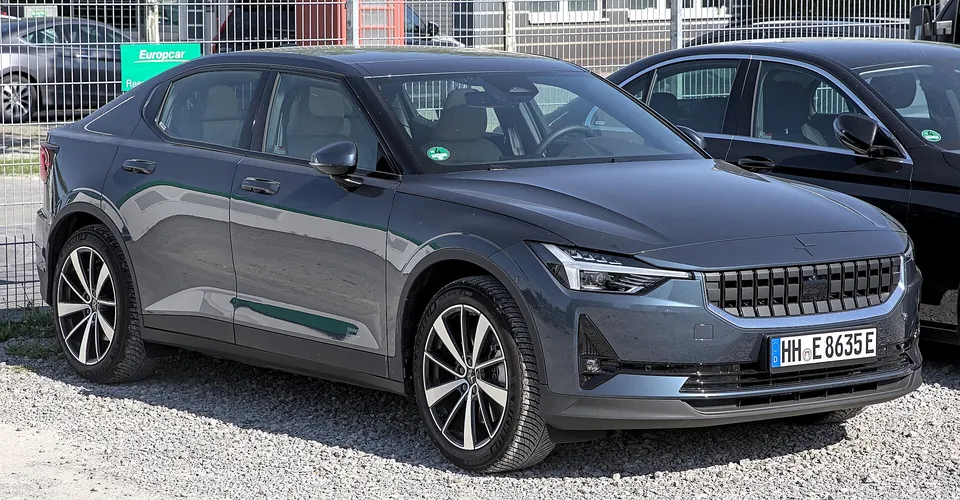
Polestar 2
Why 8.3: The most anonymous car in this category and, by the Index's own arithmetic, one of the highest-scoring: sold overwhelmingly on lease and to fleets, driven enormous distances, and treated by the used market with such total indifference that speculation never got started.
Layout
Natural habitat
Ride comfort
Sound
Motor whine, tyre roar and the occasional inverter hum, with no augmentation offered and none attempted. Polestar treats quiet as a feature rather than a problem to disguise, which is defensible, but it leaves no engine note to score.
electric · rated 0.5 / 10 for engine sound
Market value
Median asking price, good condition · €47k (2021) → €17k (2026), trending down · illustrative data
Child seats · ISOFIX
Two ISOFIX positions on the outer rear seats, the outer pair being the ones the standard covers.
The rear anchors are the supported route — the manual points child seats there, and front-passenger ISOFIX is the exception rather than the rule. A belt-mounted seat up front needs the airbag off, and cars with a rear row don't always fit a deactivation switch, precisely because the rear seats exist.
Derived from production years and seating layout, not a per-car source. ISOFIX was standardised as ISO 13216 in 1997, required on new EU model types from 2011 and on all new EU cars from 2014.
The long version
The Performance Pack is the part enthusiasts argue about — Brembo front brakes, gold seatbelts, and Ohlins dampers you adjust by hand with a spanner, twenty-two clicks front and rear, which is a wonderfully analogue thing to find under a Swedish-badged Chinese-built electric fastback. It is also almost beside the point. The Polestar 2 sold to people who needed one car, mostly through a lease, mostly in Europe, and those cars cover distances that would embarrass half the sports cars on this site. Depreciation has been brutal and entirely one-directional, which removes the last reason anyone might park one: there is no value left to protect. What you get in exchange is 402 hp, a stubbornly nose-heavy chassis set up to understeer, ride quality that never softens because the dampers are passive, and a car that will simply keep going. It scores the way it does here because the Index measures whether a car gets driven and whether it gets bought to drive, and on both counts this is close to a perfect answer.