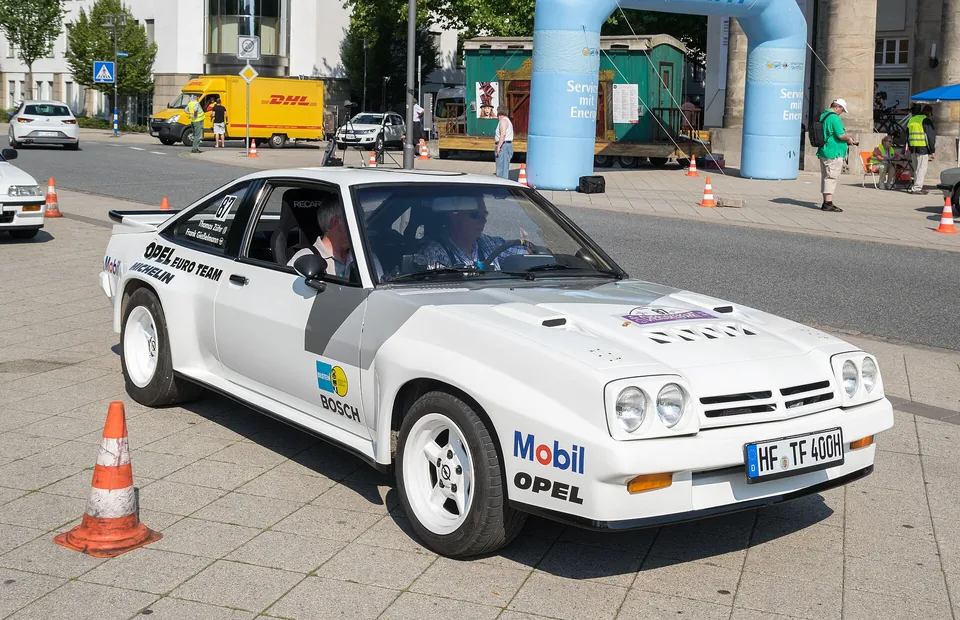
Opel Manta 400
Why 3.6: Group B wanted 200 road cars, so Opel built 245: a 2.4-litre four under a 16-valve alloy head Cosworth designed, glass-fibre arches over a much wider track, and 144 hp in a shell weighing barely a tonne. The rally version made up to 272 hp and weighed 960 kg.
Layout
Natural habitat
Ride comfort
Sound
Twin Weber 48 DCOEs on a Cosworth 16-valve head, pulling to 7,200 rpm with the induction roar coming straight through the bulkhead. But it is a homologation four rather than anything musical, and only 245 road cars were built, so few will ever hear it.
4-cylinder · naturally aspirated · 6,500 rpm redline · rated 7.3 / 10 for engine sound
Market value
Median asking price, good condition · €23k (1983) → €161k (2026), trending up · illustrative data
Child seats · ISOFIX
Built before ISOFIX existed, so there are no anchor points at all. A child seat here is a seatbelt installation, and the belt geometry of the period was not designed with one in mind.
Derived from production years and seating layout, not a per-car source. ISOFIX was standardised as ISO 13216 in 1997, required on new EU model types from 2011 and on all new EU cars from 2014.
The long version
The Manta 400 succeeded the Ascona 400 that Walter Röhrl had taken to the 1982 world championship, and it arrived at precisely the wrong moment — rear-wheel drive and two-wheel drive, against Audi's Quattro and then the mid-engined four-wheel-drive Peugeot 205 Turbo 16. It won anyway, in the events where a light, simple, endlessly rebuildable car still counted: Jimmy McRae took the 1984 British Open Rally Championship in a GM Dealer Sport car, beating the reigning world champion Hannu Mikkola to it. What that history did to the survivors is the entire entry. Two hundred and forty-five cars is a register rather than a fleet, and a large share of them were converted to full rally specification decades ago and have been campaigned, crashed and rebuilt ever since — which is why the track-day figure is high for a car of this age and the mileage figure is not. The road cars that stayed road cars are six-figure objects now, bought as investments and historic-rally entries rather than as anything anyone drives to work, and the market for them has only moved one direction since the Group B revival began. It scores above the 037 and the RS200 on this index for one reason: a Manta 400 is a modified saloon rather than a spaceframe prototype, so a meaningful number of them still get used in anger.