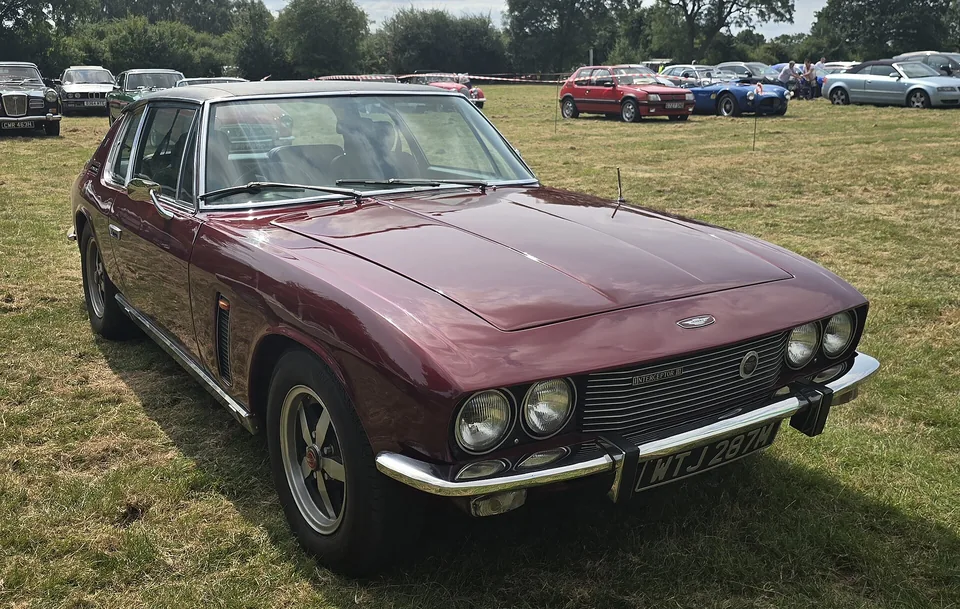
Jensen Interceptor
Why 4.6: Federico Formenti at Carrozzeria Touring drew it, Vignale built the early bodies in Italy, Jensen assembled it by hand in West Bromwich, and Chrysler supplied first a 6.3-litre V8 and then a 7.2. The result is a four-seat grand tourer with an enormous glass hatch and no pretence of subtlety anywhere.
Layout
Natural habitat
Ride comfort
Sound
A Chrysler big block through twin pipes, idling with the deep, uneven bass only a long-stroke American V8 produces. But it is capped at 5,000 rpm by a valvetrain with no interest in going further, so it is all bottom end and no crescendo at all.
8-cylinder · naturally aspirated · 5,000 rpm redline · rated 6.7 / 10 for engine sound
Market value
Median asking price, good condition · €13k (1973) → €66k (2026), trending up · illustrative data
Child seats · ISOFIX
Built before ISOFIX existed, so there are no anchor points at all. A child seat here is a seatbelt installation, and the belt geometry of the period was not designed with one in mind.
Derived from production years and seating layout, not a per-car source. ISOFIX was standardised as ISO 13216 in 1997, required on new EU model types from 2011 and on all new EU cars from 2014.
The long version
Jensen built 6,408 Interceptors between 1966 and 1976 alongside the far rarer FF, which was the first non-off-road production car with four-wheel drive and anti-lock brakes and which lost money on every example. The Interceptor was the one that paid the bills, and it did so by being exactly what a certain kind of British buyer wanted in 1969: Italian looks, American reliability under the bonnet, hand-finished leather, and a running cost nobody thought about while fuel was cheap. Then fuel stopped being cheap. The 1973 oil crisis destroyed the market for a 7.2-litre four-seater almost overnight, Jensen went into receivership in 1975, and production continued only until the parts bins ran dry in 1976. For the next thirty years Interceptors were the cheapest way into a hand-built British GT and were treated accordingly — run into the ground, rusted, and occasionally rescued. The market has since recovered hard: good cars moved from banger money to the high five figures over about fifteen years, and Jensen International Automotive's LS-powered restomods established a six-figure ceiling above them. That is what keeps the numbers here where they are. Interceptors are bought as objects and used for touring rather than commuting, and a real share of the survivors sit in collections — but the running costs are high enough that the people who own them are mostly people who want to be in one, which stops the flip factor from collapsing the way it does for the truly speculative cars on this list.