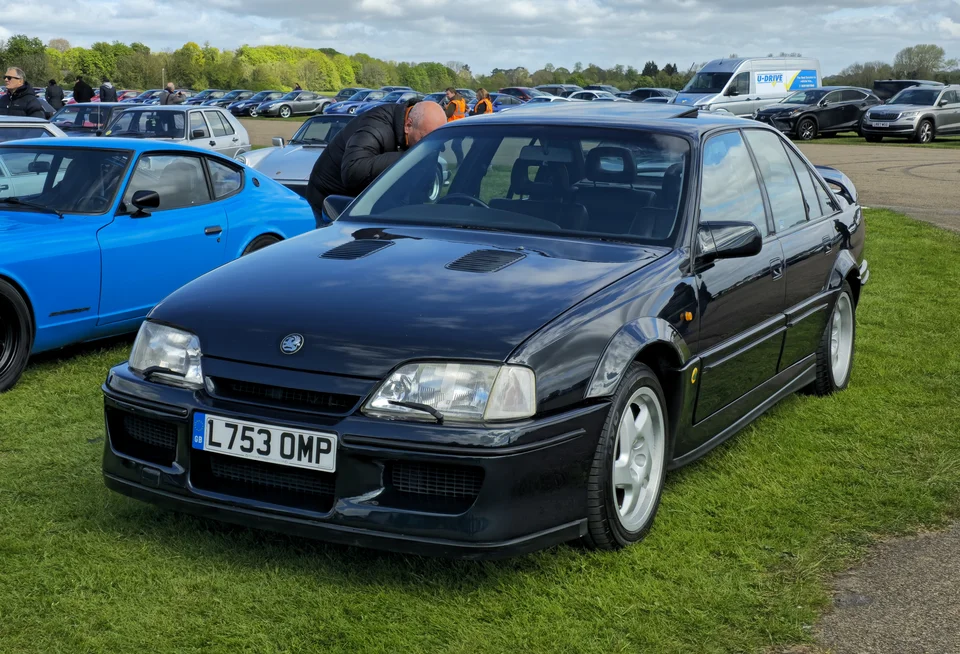
Vauxhall Lotus Carlton / Opel Lotus Omega
Why 5.9: Lotus took GM's mundane Opel Omega/Vauxhall Carlton saloon, fitted a 377-hp twin-turbo straight-six and a ZF six-speed borrowed from the Corvette, and built the fastest four-door production car in the world at 177mph — in a shape nobody looked at twice. British tabloids campaigned to have it banned from sale.
Layout
Natural habitat
Ride comfort
Sound
Two Garrett turbochargers on a 3.6-litre straight six give a low, smooth hum and an obvious whistle building through the gears. But Vauxhall left the saloon insulation intact and a six is inherently even-tempered, so the reputation rests on speed, not sound.
6-cylinder · turbocharged · 6,800 rpm redline · rated 5.9 / 10 for engine sound
Market value
Median asking price, good condition · €80k (1990) → €87k (2026), trending up · illustrative data
Child seats · ISOFIX
Built before ISOFIX existed, so there are no anchor points at all. A child seat here is a seatbelt installation, and the belt geometry of the period was not designed with one in mind.
Derived from production years and seating layout, not a per-car source. ISOFIX was standardised as ISO 13216 in 1997, required on new EU model types from 2011 and on all new EU cars from 2014.
The long version
GM handed Lotus a mundane mid-size saloon and a mandate to make it embarrassingly fast, and Lotus responded by boring the Omega's straight-six out to 3.6 liters, bolting on two turbochargers, and fitting brakes and a chassis capable of handling all 377 horsepower — enough for 177mph and a 0-100mph time that reportedly beat contemporary Ferraris, in a car that still looked like fleet-spec transport apart from subtle flares and a distinctive shade of dark green. British tabloids ran campaigns arguing it should be banned from public roads entirely, on the theory that no car this fast should wear a Vauxhall badge and be sold to ordinary buyers; Lotus and Vauxhall built 950 anyway, split between UK Carltons and European Omegas, into a recession that made a car pricier than a contemporary BMW M5 a hard sell regardless of the badge on the boot. Unlike the mid-engine Italian and French exotics in this batch, nobody buys a Lotus Carlton to look at — the entire appeal is the sleeper act, a car that reveals nothing until the driver plants the throttle, and that keeps the ownership pattern skewed toward people who actually want to use the performance rather than photograph it. It never came to the US, so American interest is purely aspirational grey-market territory, but UK and European owners still drive theirs with a regularity the seven-figure Group B cars in this batch never see.