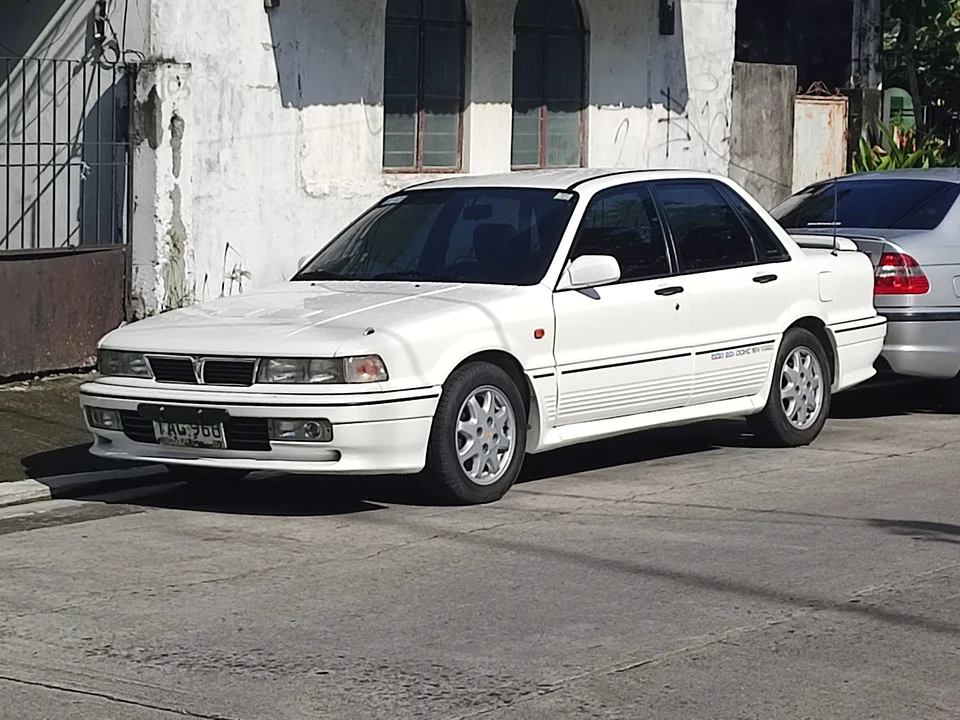
Mitsubishi Galant VR-4
Why 7.0: The 4G63T turbo four and AWD driveline the Lancer Evolution would inherit wholesale, wrapped in an unassuming four-door sedan Mitsubishi actually sold new in the US for about $22,000. It won rallies in Group A before Mitsubishi retired it in favor of the smaller, lighter Lancer Evolution — the car everyone actually remembers.
Layout
Natural habitat
Ride comfort
Sound
The 4G63 has a gruff, hard-working thrum and the turbocharger is clearly audible under load. But a saloon exhaust, a mundane four-cylinder and no acoustic ambition anywhere leave it among the more forgettable noises here, whatever the hardware underneath.
4-cylinder · turbocharged · 7,000 rpm redline · rated 4.7 / 10 for engine sound
Market value
Median asking price, good condition · €20k (1991) → €18k (2026), trending down · illustrative data
Child seats · ISOFIX
Built before ISOFIX existed, so there are no anchor points at all. A child seat here is a seatbelt installation, and the belt geometry of the period was not designed with one in mind.
Derived from production years and seating layout, not a per-car source. ISOFIX was standardised as ISO 13216 in 1997, required on new EU model types from 2011 and on all new EU cars from 2014.
The long version
Every enthusiast knows the Lancer Evolution's turbocharged 4G63 and AWD driveline; far fewer remember that both existed first in the Galant VR-4, campaigned in the WRC's Group A class through the late 1980s and early 1990s before Mitsubishi built the smaller, more focused Evolution specifically to keep winning against the Impreza and Escort Cosworth. That makes the VR-4 the direct ancestor of one of the most collected homologation lineages in JDM history, and yet it trades for a fraction of even an early Evolution's price — Mitsubishi actually sold it new in America, unlike almost everything else in this batch, which keeps it off any Forbidden Fruit list but has done nothing for its collector cachet. A clean US-spec sedan with the manual gearbox and all-wheel drive still changes hands for well under $20,000, genuinely cheap for a car with a rally-winning drivetrain and a direct line to the Evo's DNA. That price has produced exactly the ownership pattern cheap performance cars always produce: real enthusiasts who know what's underneath, driving it because there's no investment value left to protect.