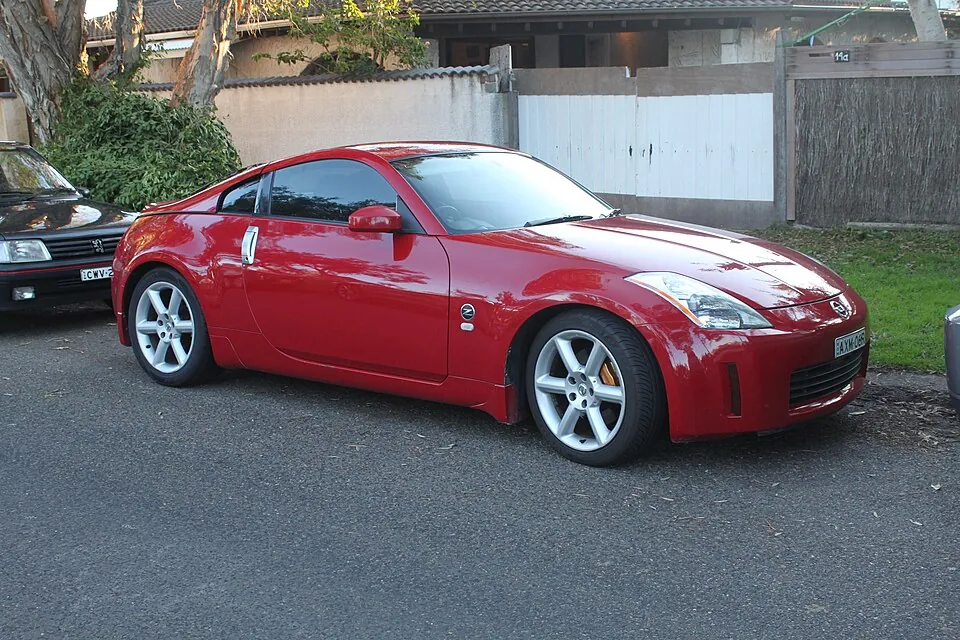
Nissan 350Z (Z33)
Why 8.6: After eight years with no Z on sale at all, Nissan came back with a 3.5-litre V6 in a short, stiff front-midship chassis and priced the base car near $26,000. That combination — rear drive, a proper manual, no turbochargers to rebuild — made it the default first performance car for an entire generation, and the ownership numbers still show it.
Layout
Natural habitat
Ride comfort
Sound
The VQ35 is all induction, the airbox close enough to the bulkhead that you hear it over the exhaust. But the engine is genuinely coarse, thrashing rather than hardening towards 6,600 rpm, so this is a loud six rather than a good one.
6-cylinder · naturally aspirated · 6,600 rpm redline · rated 6.3 / 10 for engine sound
Market value
Median asking price, good condition · €25k (2003) → €17k (2026), trending down · illustrative data
Child seats · ISOFIX
There aren't any — strict two-seater.
The only position there is — and the weak point of this era. Airbag cut-off switches only became routine in the mid-2000s; many of these cars have none from the factory, which rules out a rear-facing seat entirely unless a dealer-fitted deactivation was installed. Forward-facing on the belt, seat slid fully back, is what the period manuals allow.
Derived from production years and seating layout, not a per-car source. ISOFIX was standardised as ISO 13216 in 1997, required on new EU model types from 2011 and on all new EU cars from 2014.
The long version
The Z33 exists because Carlos Ghosn agreed the Z had to come back, and it came back deliberately cheap: base price near $26,000 in 2003, when a Boxster cost twice that. Underneath is the FM — Front Midship — platform shared with the Skyline, with the V6 set well back behind the front axle line, and Nissan spent the money on structure rather than toys. Power grew across the run, from 287 hp in the original VQ35DE through the 300 hp Rev-up engine to 306 hp when the VQ35HR arrived for 2007 with a higher redline. Because it was cheap, quick and rear-wheel drive, it became the car people learned on, which cuts both ways: a large share have been modified, drifted, tracked, or crashed, and clean unmodified examples are now noticeably harder to find than the production numbers suggest. What has not happened is speculation. Values bottomed around ten thousand dollars in the middle of the last decade and have only crept up since, so nobody is storing one, and the miles keep going on. That is close to the ideal outcome as far as this index is concerned — a sports car that stayed affordable enough to be used up.