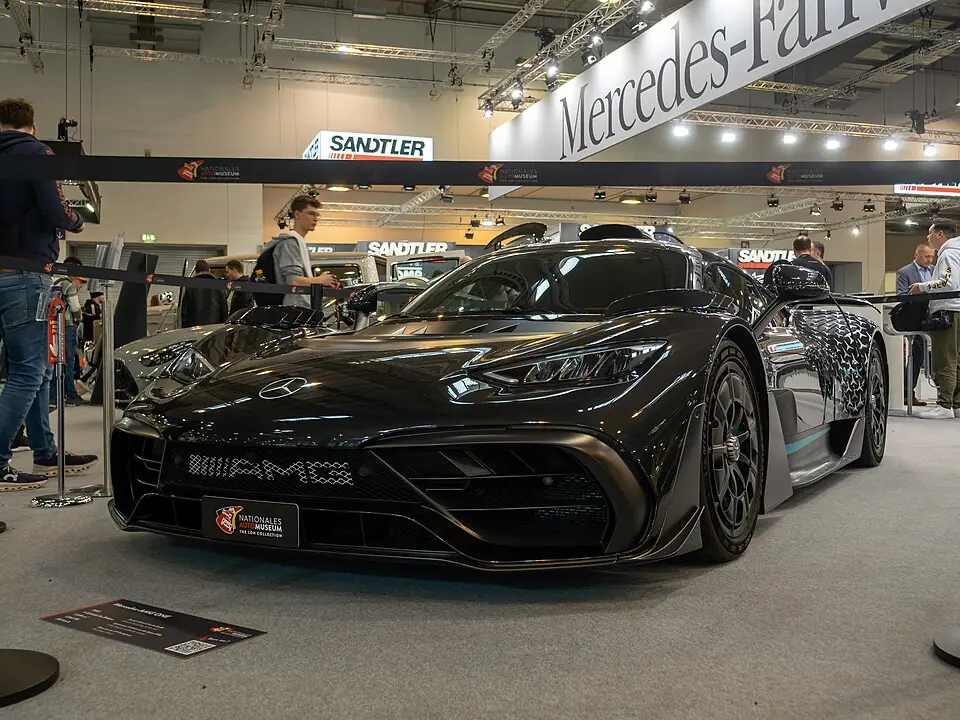
Mercedes-AMG One
Why 2.8: The turbo-hybrid F1 V6 spinning to 11,000 rpm is as close to a race engine as any road car has ever gotten, but four electric motors, AWD torque vectoring and a hybrid energy-recovery system filter almost everything through software — that electronic load is the lens keeping this out of Valkyrie territory, not the powertrain.
Layout
Natural habitat
Ride comfort
Sound
A literal Formula 1 power unit, detuned and idling like it resents the road. But it is a turbo V6, and the modern F1 sound is thinner than the V10s and V12s it replaced — extraordinary, provocative, and not actually the best noise here.
6-cylinder · turbocharged · 11,000 rpm redline · rated 8.5 / 10 for engine sound
Market value
Median asking price, good condition · €2.5M (2022) → €3.3M (2026), trending up · illustrative data
Child seats · ISOFIX
There aren't any — strict two-seater.
The only position there is, so makers of this era equip it: expect a passenger-airbag cut-off (key switch or occupant sensing) as standard, because there is no rear row to point children to. Whether the seat itself carries ISOFIX anchors is maker-specific — Porsche bundles them with its child-seat preparation, Ferrari sold them as an option, others are belt-mount only with the airbag off.
Derived from production years and seating layout, not a per-car source. ISOFIX was standardised as ISO 13216 in 1997, required on new EU model types from 2011 and on all new EU cars from 2014.
The long version
Mercedes spent nearly six years turning a genuine Formula 1 hybrid power unit into something that could survive road use, and the result is a car whose maintenance requirements have become almost as famous as its lap times — services measured in the tens of thousands of dollars, an engine with F1-grade rebuild intervals, dealers with only a handful of technicians qualified to touch it. Owners vetted for genuine enthusiasm still find themselves limited less by desire than by scheduling around the car's own mechanical fragility. What driving happens skews heavily toward supervised factory and track events.